Why They’re Harmful & What to Use Instead – 4-Legger
⏱ Estimated reading time: 6 min read
We didn’t start 4-Legger because we wanted to be just another dog shampoo company.
It was because we were frustrated and angry having just lost our precious toy poodle Henry Clay to cancer caused by exposure to environmental toxins – many of which are common in shampoo.
Like so many pet parents, we thought we were doing the right thing.
We picked up shampoo bottles that said things like “All Natural”, “Plant-based”, “Derived from Coconuts”, and “Gentle”.
And … we believed them.
We glanced at the ingredient list, but we didn’t really question it.
We didn’t stop and ask: “Are sulfates safe for my dog?”
Here’s the truth:
👉 Not all shampoos are created equal and sulfates are one of the reasons why.
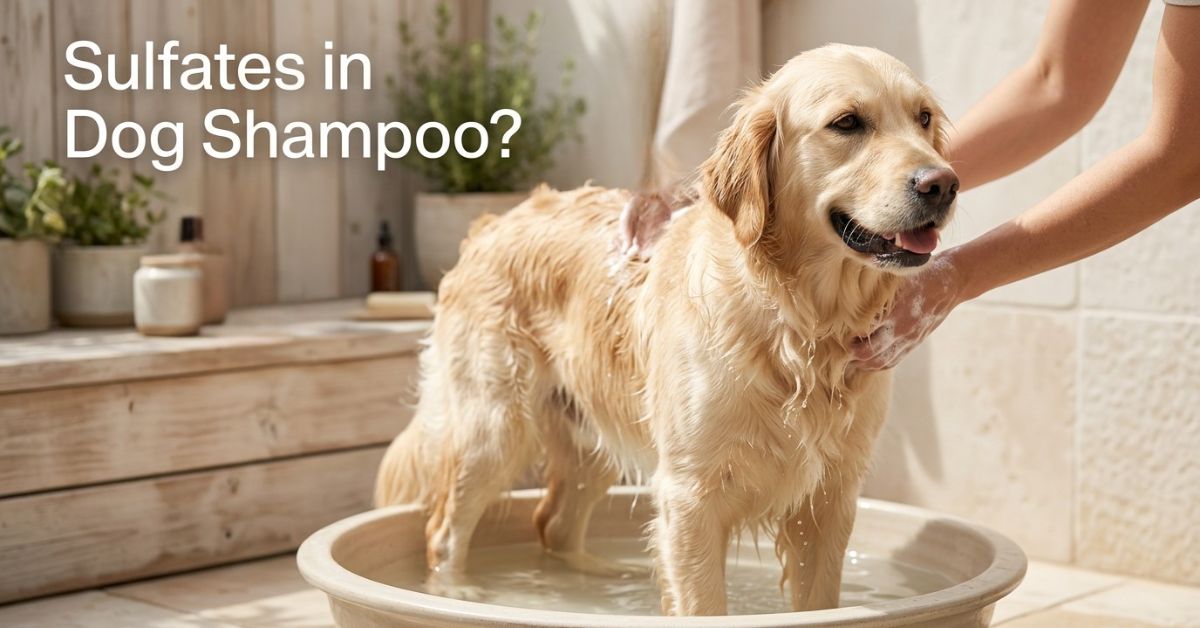
🧪 What Are Sulfates in Dog Shampoo?
Sulfates are detergents made from synthetic ingredients which are designed to:
- Create lather (that big foamy effect people love)
- Break down and strip away oil and dirt
The most common sulfates you’ll see in dog shampoo are:
- Sodium Lauryl Sulfate (SLS)
- Sodium Laureth Sulfate (SLES)
- Ammonium Lauryl Sulfate
They’re widely used because they’re inexpensive and they create that “squeaky clean” feeling that pet parents have been conditioned to expect.
But that “clean” feeling comes at a cost…
⚠️ Why Sulfates Can Be Harmful for Dogs
Your dog’s skin is very different from yours: It is thinner and more sensitive.
Like yours, it is also protected by a delicate balance of natural oils and a living microbiome.
When you use a sulfate-based shampoo, it doesn’t just remove dirt.
👉 It can strip away the natural oils your dog actually needs.
Over time, this can lead to:
- Dry, flaky skin
- Increased itching and scratching
- Dull, brittle coat
- Disruption of the skin microbiome
- Greater sensitivity to allergens (especially in spring and fall)
Sound familiar?
This is why so many dog’s skin is fine for a while… but then suddenly develops skin issues that feel like they came out of nowhere. We’ve heard it in emails hundreds of times, “my dog has always been healthy but all of a sudden…” Unfortunately, there is no “all of a sudden” because even low dose exposures to harmful ingredients overtime will often be the tipping point between your healthy dog and your all-of-a-sudden sick dog.
That repeat stripping of oils and the microbiome leaves your dog’s skin without the ability to replenish.
🌿 The Hidden Problem: “Naturally Derived from Plants”
There are a LOT of dog shampoos on the market that make the claim “naturally derived from plants” to get you to buy them.
That claim is a bit misleading. Actually, it’s a LOT misleading.
👉 A sulfate like Sodium Lauryl Sulfate can be derived from coconut oil (which sounds great… but it doesn’t begin to resemble a coconut after all of the chemical reactions it has gone through to be processed into the final ingredient used in your dog’s shampoo.
To get to the final ingredient, it goes through multiple industrial processing steps and chemical reactions – transforming it into a sulfate detergent (100% synthetic) that behaves very differently from the original ingredient (100% natural coconut).
Why? Because it isn’t coconut oil anymore. It is a powdered, synthetic ingredient!
It is similar to how kibble is made.
It may begin with recognizable ingredients, but after multiple processing steps and transformations, it no longer resembles – or behaves like the starting ingredient. Nor does it have the rich nutrients of that original fresh food.
Starting from coconut doesn’t mean it stays coconut – just like kibble doesn’t stay whole food.
So while it may technically be “plant-derived”…
❌ It’s now a surfactant that can strip the skin and disrupt your dog’s natural skin balance.
“Plant-derived” does NOT equal gentle or safe.
🐶 Why This Matters More Than Ever
Dogs today are dealing with more skin issues than ever before:
- Environmental allergens
- Over-bathing with harsh shampoos
- Compromised immune systems
- Exposure to synthetic chemicals
- Poor nutrition resulting in gut issues manifesting on the skin
And every time we wash them with a stripping shampoo…
👉 We’re resetting their skin in the wrong direction.
✅ What to Use Instead of Sulfates
If sulfates are part of the problem, what’s the solution?
Sulfate free dog shampoo, of course!
Look for shampoos that use:
✔️ Gentle, non-stripping cleansers with Ingredients that Support the Skin
Saponified oils are mild, cleansing ingredients that go through minimal processing from being a coconut on a tree to being the 100% natural shampoo in the bottle.
✔️ Formulations that respect the microbiome
- No synthetic ingredients including fragrances
- No artificial colors
- No harsh preservatives
- Botanicals that actually support the skin
🌱 The 4-Legger Difference
At 4-Legger, we believe dog shampoo should be holistic – meaning – it should support your dog’s whole body – not work against it. You can feed your dog the most natural, species appropriate diet on the planet, but if you’re still using detergent-based grooming products on their skin, you are not supporting your dog holistically.
That’s why every 4-Legger shampoo is:
- A true sulfate free dog shampoo
- Made with real, 100% natural ingredients
- Formulated to to support the skin barrier
- Crafted with organic botanicals, not synthetic ingredients
Instead of stripping the coat…
👉 Our shampoos work with your dog’s natural physiology.
🛁 Our Best Sulfate-Free Options for Reactive Skin
If your dog struggles with itching, dryness, or seasonal sensitivity, these are great places to start:
🌼 Lavender with Calendula
- Soothing for sensitive or irritated skin
- Great for dogs prone to itching
🍃 Lemongrass & Aloe
🌿 Lemongrass & Hemp
🍊 Orange Neem
🐾 The Bottom Line
Sulfates might make an abundance of shampoo foam but more foam does not mean more clean.
And they can also strip away the very things your dog needs for healthy skin.
Once the skin barrier is compromised, everything else – itching, irritation, sensitivity – tends to follow.
Choosing a sulfate-free shampoo isn’t just a trend. It’s a foundational step in supporting your dog’s long-term skin health.
ALL 4-Legger shampoo formulations are sulfate-free because healthy only happens when ingredients support that goal.