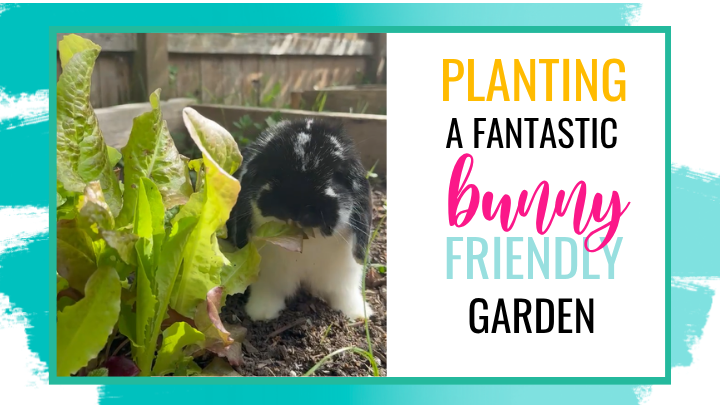
Feeding your bunnies better with a rabbit friendly garden
⏱ Estimated reading time: 9 min read
as an impulsive, enthusiatic ADHD HOT MESS, I JUMPED INTO HAVING RABBITS WITHOUT DOING ALL THE RESEARCH.
I don’t recommend it. It’s very irresponsible. Like, all’s well that end’s well, but honestly, a touch of caution and research would have served me well.
I wasn’t fully uninformed. Obviously, I was willing to learn and would absolutely provide my rabbits with the best of everything. You all know I have a track record for spoiling the HECK out of my pets. I had been a volunteer at a shelter serving our wild and overgrown feral, domestic rabbit population for years. Small animal nutrition is my jam. I had fostered and had several absolutely lovely bunny beans in my home to experience first hand. I was extremely well versed on the space requirements for rabbits. (Which let me tell you are WAY more space than anyone assumes. We recommend a space 4 ft. long x 4 ft wide minimum with enough space to hop 3-4 times uninterrupted. My spoiled little guys have free reign of an entire room.)
So I didn’t go into it blind.
but I definitely didn’t go into it knowing exactly every single thing my rabbits would need to thrive.

There are so many way to provide enrichment for your from toys to tricks and everything in between. Did you know you can teach rabbits to do tricks?! Yeah, it’s super cool and Puffin is very impressive. The key to great, species appropriate enrichment is to identify the natural skills your pet would display if they were self sufficient. Then provide opportunities to use those skills. Think about things like:
– how to encourage them to use all their senses
– engage their brains
– get active
– fulfill social needs
– make feeding more interactive.
Enrichment through feeding is one of the best ways to keep your rabbit healthy and engaged. And while those of us who had rabbits growing up might think that all rabbits need are pellets and hay, this is wildly inaccurate! Rabbits do need unlimited access to hay and there’s no harm in providing a small amount of species-appropriate pellets, but they only thrive when they’re served a diverse diet full of leafy greens, safe vegetables, edible flowers and when they can use foraging behaviours.
What is foraging behaviour?
For domestic pets, foraging is giving them a change to display natural behaviours by creating ways to let them find their own food sources. In the wild rabbits spend a huge portion of their days looking for food and they’re considered to be “gourmet” foragers meaning they don’t just look foir plants that are edible, they look for the tastiest, most nutritious parts of those plants choosing the perfect leaves, digging for the roots, or chewing bark depending on what plants they’ve found.
I am so lucky to be living in a spot where we don’t just have the space for ample bunny gardens, but also a climate that means our growing season is long. And there are tons of ways to preserve your summer harvest, so it will serve your bunnies all winter long. And when my favourite bunny treats are climbing to $10 a box (worth it but wow), being able to lean into making more rabbit treats at home is a huge win.
Rabbits need fresh produce to have a nutritionally complete, well rounded diet.
Did you know that the stereotypical rabbit with a carrot is not actually very good for them? Fresh carrots contain a lot of natural sugars and while they’re a healthy part of human diets, they should be treated like a treat in rabbit diets.
What bunnies really needs is 1-2 cups of fresh, dark, leafy greens per every four lbs of body weight every darn day. That’s a lot of produce – and in this grocery market – I am so lucky to be able to grow a lot of it at home.
How to create the perfect forage garden for your rabbitS
Decide what kind of garden space you want
- Find a dedicated space – or dedicated spaces if your bunny is SUPER spoiled. The key is to group rabbit-safe plants together, so everything they could potentially eat in the space is safe and healthy for them.
- Choose a garden format that works for you. We have several raised garden beds that allow me to create small spaces filled with rabbit appropriate plants, but also keep them small and manageable, but this is in no way required! You can grow a bunny garden directly in the ground, in raised beds, or even in containers. The space works for you; you don’t work for the space so use what you have and what makes sense for your home.
Make your garden safe for your bunny to spend time in
Rabbits are prey animals meaning they startle easily, run fast, and hide well. You don’t want to take them outside to enjoy themselves and then lose them or let them get sick or injured. My worst nightmare honestly and what kept me from bringing them outside for a long time, but in the end? Both Puffin and Otter are SO DANG HAPPY outside that I think the potential risks are worth the benefits to their quality of life, as long as I do it thoughtfully.
Keep them from escaping
- I love using garden fences on stakes to add fencing around my garden. They’re easy to pup into the ground when needed and they pull out so easily when they’re not.Other great options include
– foldable baby or pet fences
– rodent wire screen (but not chicken wire) fencing
– or, if you have a super agreeable bunny like Puff? A bunny safe leash and harness.The leash and harness are definitely the trickiest, You need the calmest, most stable bunny to make this safe. Jumping and pulling on a leash can be very hard on a bunny’s neck and lead to injury quickly. If you want to try it, always proceed with caution and make sure you’ve trained thoroughly and well before moving outside. These tips can help.
KEEP YOUR BUNNIES SAFE FROM PREDATORS
For a lot of other animals, your rabbit kind of looks like a tasty snack. No one has ever told Puffin he’s edible and his absolute overconfidence when he’s out in the yard knowns no bounds, so it’s on me to ensure he is safe from other animals. Knowing what predators there are in your area is key to knowing how to best protect your rabbit.
BIG LAND ANIMALS
Starting with a great fence is never a bad first step, if your property makes that possible and your budget allows for it. This gives you an extra way to keep out animals. Where we are is alive with tons of diverse wildlife. It’s not rare to see deer in our neighbor’s yard or our driveway. There is a cougar who comes and goes. I’ve never seen one in my neighborhood, but there are apparently bears. Even neighborhood dogs could be a danger to your bunny. I appreciate the barrier the yard’s fence gives us.
SMALL LAND ANIMALS
it’s definitely harder to keep out smaller animals like cats, raccoons, squirrels and rats. Don’t underestimate them though – many of these animals will fight your bunny if given a chance. Since I can’t exactly prevent these crafty little critters, I supervise my bunnies 100% of the time when we’re in the yard. If a small menace should wander into the yard, I can intervene long before there’s a risk.
- Birds, birds, birdsThese are honestly my biggest worry. Especially living on Vancouver Island where we are so. darn. close to a large bird sanctuary. A bird scooping up teeny tiny Puffin who doesn’t have an ounce of self-preservation in his adorable little orb of a body is my nightmare. Hawks, eagles – even crows – can grab a bunny if they’re desperate enough.
Last summer my awesome roommate made the buns an outdoor enclosure space that had a rodent wire top keeping them fully enclosed and safe and I’m so grateful. I’d LOVE to create a larger outdoor area for them with bird net, but until then, this is another supervision is key issue for me.
PROTECT YOUR RABBITS FROM DISEASES AND PETS
- If there is one super scary, very contagious, hard to control the spread viral rabbit disease that scares me – it’s RHD and RHD2. Rabbit Hemorrhagic Disease is highly contagious and almost always fatal with mortality rates up to 95%. It’s been popping up in both wild and domestic rabbit communities all over Europe and North American – including in our town. I would never risk taking my bunnies outside without ensuring they were up to date on their RHD vaccinations.
- Rabbits are also susceptible to fleas, ticks and mites – just like your cat or dog. It’s not common to put them on a preventative.Given how small they are and how sensitive their systems are? I’d be reluctant to anyway. I rely on wiping them with a pet-safe scent based bug repellent wipe before we go out. Then, I brush them out thoroughly with a nit comb when we come in. I also…lint roll them for a little something extra which sounds so silly but works great.
Choose your plants wisely – not all flowers, veggies or fruits are safe and healthy for your rabbit.
Our rabbit garden in a mix of the staples – dark leafy greens and fresh herbs, the veggies that are frequently fed fan favs around here and then, mixed with a few fun things like fruit plants and edible flowers.