Travelling with your dog in the car
⏱ Estimated reading time: 8 min read
The Dog Car Restraint – I see so many people in my line of work, with dogs free, un-tethered in the car. Up high on a van seat just waiting to shoot like a missile into the wind screen in the event of a sudden stop.
No one wants this, but it’s overlooked by pet parents and what they don’t know, is they can be fined.
When travelling with your dog in the car, it’s easy to be distracted by your dog while you’re driving, but with some extra knowledge and better planning, we can help you make your journey safer. Read our blog to find out the implications with regard to your vehicle insurance, what the Highway Code says and what is the best equipment to buy.
Shop Car Leads! Our Dog Car Restraints are the perfect safety restraint for travelling with your dog in the car, read more about our recent BS EN ISO testing
National Highway Transportation Safety Administration (NHTSA) say that even a distraction of 2 seconds can increase your risk of a road traffic accident (cnn.com). You wouldn’t consider having a loose cat in your car, so why allow your dog to travel unsecured?
According to a survey carried out by the AA, 23% of dog owners said that they needed to restrain their dog while braking. The article goes on to say that 19% of drivers took one hand off the steering wheel to prevent their dog from climbing on to a front car seat. While 17% owned up to allowing their dog to sit on their knee in the car.
Car Travel Stats
- In the years 2019-2020, there are an estimated 9 million dogs being kept as pets is 23% of households
- There are over 43m with pets (other animals as well as dogs)
- 16% who travel with their dogs restrain then properly
- 60% have driven whilst distracted by pets
- 53% have petted their dog while driving
- 13% admitted to giving treats to their dog while driving
- and 4% actually played with their dog while driving!
The Highway Code Rule 57 (UK) 2020
“When in a vehicle make sure dogs or other animals are suitably restrained so they cannot distract you while you are driving or injure you, or themselves if you stop quickly. A seat belt harness, pet carrier, dog cage or dog guard are ways of restraining animals in cars.” Source: www.askthe.police.uk
It is not a legal requirement, but failure comply with the Highway Code may be used as evidence in a court of law under the Traffic Acts to enable them to establish liability.
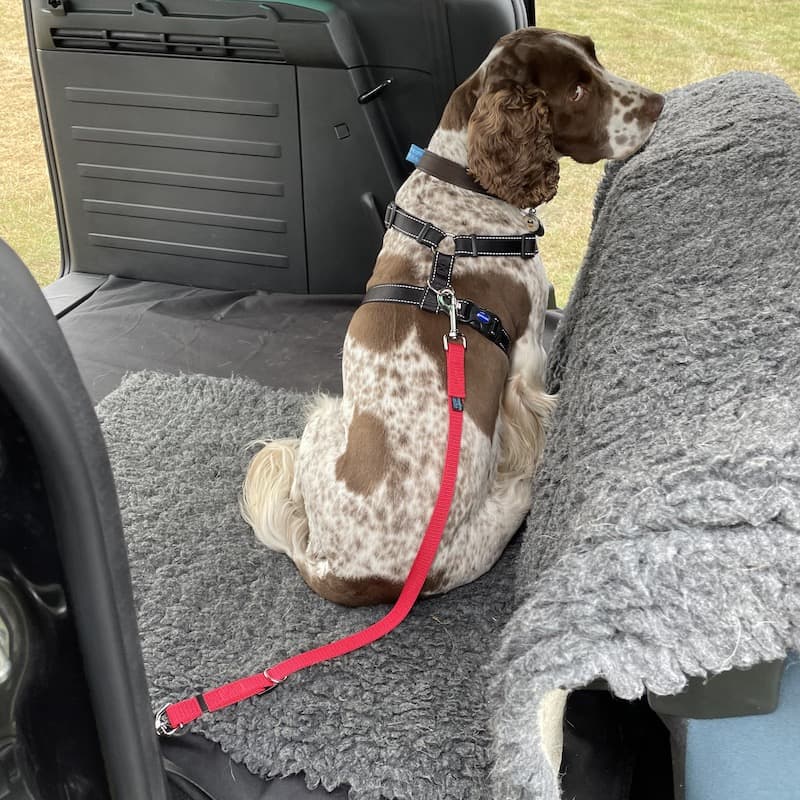
The Highway Code recommends drivers fit their dogs with a suitable harness like the one we recommend – the Ezy Dog Drive Crash Tested Car Harness, use a pet carrier or cage (securely anchored down), or a dog guard as a way to restrain an animal while travelling in a vehicle.
The RAC warns drivers
The RAC says drivers face heavy fines of up to £5,000 if they don’t safely restrain their pets, this, of course, includes cats, but any animal unrestrained like to cause distraction is included. You may also face having your insurance invalidated.
Quoteline Direct
Taken from the Quoteline Direct website, it says, in the event of an RTAS, if it can be evidenced that your pet was not safely secured, they could become a very expensive passenger.
Careless driving is an offence under section 3 of the Road Traffic Act which states that “If a person drives a mechanically propelled vehicle on a road or other public place without due care and attention or without reasonable consideration for other persons using the road or place, he is guilty of an offence”.
– Quoteline Direct
This piece of legislation is open to interpretation as it is designed to cover all minor traffic violations. If found in breach of this law, you could be issued with 3 points which will increase your car insurance and possibly a fine up to £2,500 and a discretionary disqualification.
What is the best dog car harness?
We recommend using the Ezy Dog Drive Crash Tested Dog Car Harness. It is designed to keep your dog secure in the car and doubles up as a walking harness, so you can use the same harness when you reach your destination.
This dog car harness can be used with any of our car restraint range to securely attach your dog to a floor anchor or headrest.
Preparing for & travelling with your dog in the car.
Essential advice:
- Ask your vet to scan your dog to check the chips’ location and make sure the details are up to date
- Prepare for your dogs car travel well before the travel day.
- Make sure the car is kitted out with their blankets & bedding in their travel area and don’t forget spares.
- Take fresh water and sturdy containers to replenish the water.
- No-spill or travel bowls are ideal. The fold-flat ones are great space savers.
- A good quality car harness & a car boot lead, plus spares.
- Any medications that your dog might need, make sure you have enough.
- Emergency telephone numbers for the vet. Leave numbers at home for anyone that might be caring for your pets that have to stay at home.
- Plan the route so you know where you can safely stop.
- Make sure there is two of you so one can take care of the dogs while the other takes toilet breaks, gets food etc to avoid leaving them alone in the car.
- Don’t leave without your poop bags! Be sure to take plenty plus a spare sturdy bag in case you can’t bin them straight away.
- A spare collar and lead, one for each dog. I carry slip leads for any stray dogs you might encounter!
- Copies of vaccination cards, even if on your phone.
- A basic grooming kit, to include a tick remover.
- Small medical kit including bandages and vet wrap bandage.
- A suitably sized metal or soft fold flat cage.
- Personal items such as a favourite toy or a safe chew.
- A bag or a tub for all of the above items to be stored in.
- ID photos of your dog in the event of the unthinkable.
- Make sure their microchips are checked for location (on the dogs’ body) and that your contact details are up to date.
- Don’t feed large amounts immediately before you travel with your dog. Feed a good 2 hours before travel.
- Plan ahead for toilet and food breaks.
- Never allow your dog to sit on a car seat without a restraint, they could jump on you or get under the pedals, and god forbid there is an accident, your dog could escape.
- Plan ahead for breathers to just get out of the car and take a break to stretch legs etc.
- Be aware that your dog cannot ask to go out for a potty break like they would at home, nor will they be as willing in a strange place.
- Be aware of nearby vet clinics.
- Never ever ever ever leave your dog unattended in a car and certainly never leave them in a hot car.
- Keep windows closed or open a safe amount so they cannot jump out.
- When stopping in strange places always have your dog tethered in the car so they cannot escape when you open doors or the car boot, even better use a crate for our dog.
- Be aware of their needs whilst travelling as it will be strange for them and not all dogs like travelling in cars.
Consider behaviour & health when travelling with your dog in the car
- prepare the day before so as not to rush around last minute causing stress for everyone, including your dog/s (trust me, I know)
- take time to help your dog settle
- travel to nice places rather than just the vets. Go on walks to the woods or the beach, somewhere your pet will associate with nice things
- consider car sickness/motion sickness
- consult a professional trainer or behaviourist should your dog struggle with the concept of car travel
- train certain behaviours associated with the car, examples might be to wait until you tell them to get in the car, to wait until you say get out, this sort of thing. Lie down or settle, is a good way to encourage your dog to be calm in the car
- bear in mind your dog might find car travel odd
- don’t leave travelling a distance with your dog till the last minute. Take them out on journeys to find out how well they travel
- be considerate if your dog doesn’t handle car travel so well. It might be kinder to leave them with a competent carer like a family member, a pet sitter or a nice luxury dog boarding kennel
Accommodation dilemmas when you teach your destination
- Double check your room / accommodation allows pets
- Also check the number of pets you are taking is allowed, many have a maximum pets allowed rule
- Ask to be on the ground floor and near to a door so you can take your dog/s out to the toilet
- Take some cleaning kit with you to avoid charges for soiling a room
- Check if and when dogs are allowed on beaches you intend to travel to