Ainoshima Cat Island: the perfect Fukuoka day trip itinerary
⏱ Estimated reading time: 21 min read
Last Updated on 20 May 2026 by Vanessa
Planning a trip to Ainoshima? This small island just off the coast of Fukuoka is one of the easiest and most unique day trips you can add to your itinerary, especially if you’re curious about Japan’s famous cat islands.
In this guide, I’ll walk you through exactly how to visit, from transport and ferry tips to where to eat, stay, and what to visit on the island. It’s based on real experience and includes several things I wish I had known before going.
Whether you’re mapping out a Fukuoka day trip or building a full Fukuoka itinerary, this will help you plan your visit to Ainoshima without any guesswork.
👉👉 Want to visit more cat islands in Japan? Here’s my guide to the ones that are genuinely worth your time.

This is a guest post by Chieko Shiraishi.
Ainoshima: the perfect Fukuoka day trip
Ainoshima is a small fishing island off the coast of Fukuoka that became famous as a “cat island.”
In Japan, places where large numbers of free-roaming cats live are often called “cat islands.” Most of them are small fishing communities where cats originally helped control rats around ports.
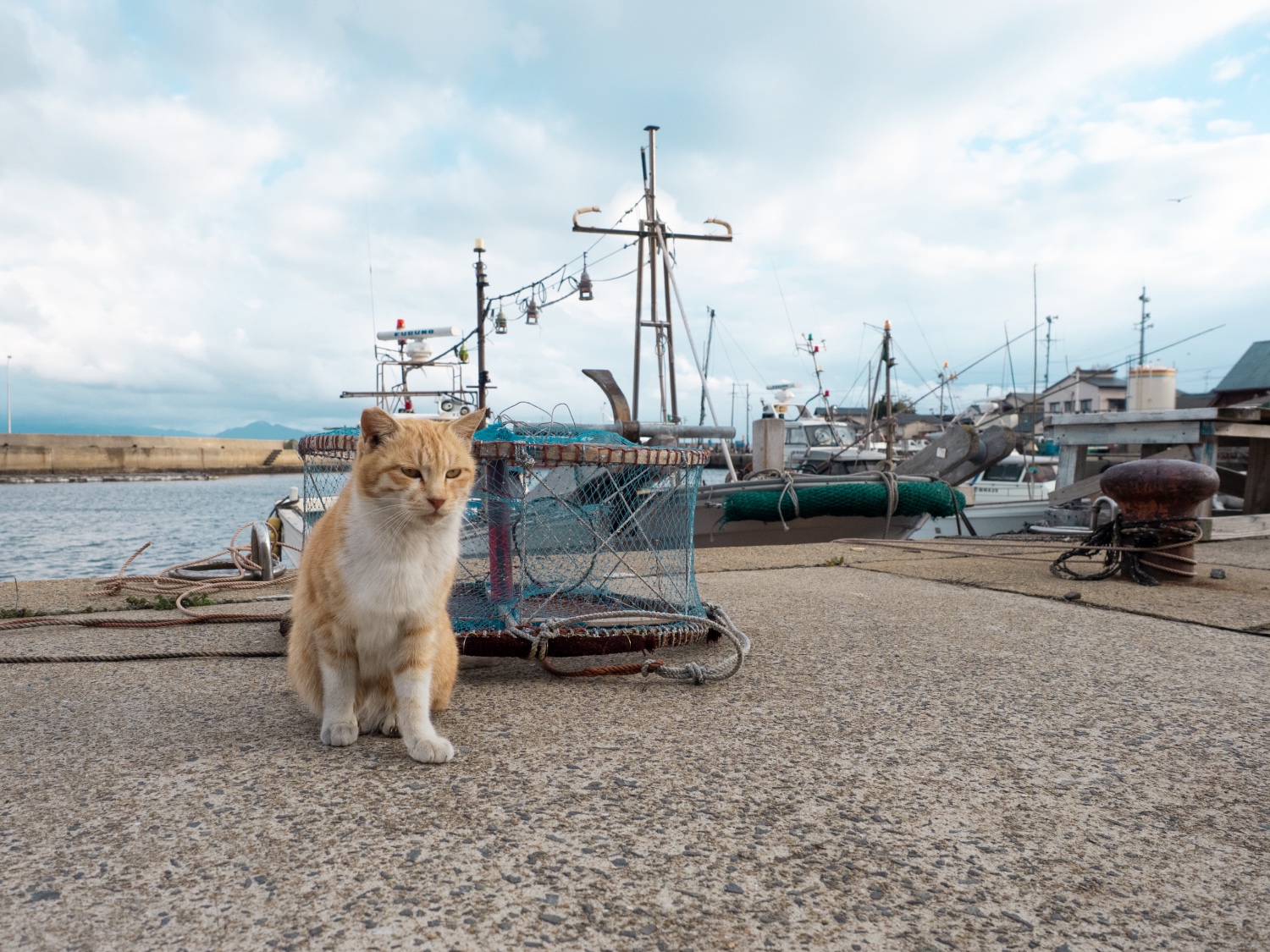
According to the Ainoshima Cat Association Facebook page, around 150 cats live on Ainoshima. Most of them stay near the port where visitors arrive, so you start seeing cats almost immediately after getting off the ferry. Some nap beside fishing boats, while others follow tourists around hoping for attention.
Most cat islands in Japan are difficult to reach, but you can get to Ainoshima in roughly 1 hour from central Fukuoka, which makes it one of the most accessible cat islands in the country.
How did Ainoshima become cat island?
The island did not originally become a cat island on purpose. Local fishermen kept cats to help control rats around fishing equipment and storage areas. Over time, the cat population grew naturally while the number of island residents slowly declined.
For many years, Ainoshima remained relatively unknown outside Japan. That changed after Fubirai’s photos of Fukuoka’s cats started spreading online in the early 2010s. They later went viral on BuzzFeed, and CNN later included Ainoshima in a list of the world’s best places for cat lovers. Since then, the island has turned into one of Japan’s most famous cat islands alongside Tashirojima and Aoshima.
Don’t like cats? Ainoshima can still be a great Fukuoka day trip.
Would I recommend Ainoshima to people not interested in cats?
Absolutely. Even with its popularity, Ainoshima still feels like a real working fishing village rather than a tourist attraction built around cats. People still live here, fishing boats still come and go from the harbor, and daily life continues at a slow pace around the island.
It’s a fantastic Fukuoka day trip for anyone who likes the atmosphere of small Japanese islands or fishing ports.
Also, it has a good balance of shops, is close to a big city, and offers peaceful, scenic views.
How to get there
Ainoshima is one of the easiest cat islands to visit, especially if you’re already in or near Fukuoka, which is a major city with excellent transportation access and many flight options.
The following route is the most common for travelers coming from Hakata:
Haneda Airport → Fukuoka Airport
First, take a flight from Haneda Airport to Fukuoka Airport. The flight is about 2 hours, and there are lots of flights every day, so it’s easy to find one that fits your schedule. You can find the cheapest tickets here.
Fukuoka Airport → Hakata Station
After landing at Fukuoka Airport, hop on the Airport Line subway to Hakata Station. You’ll get to Hakata in about 5 minutes.
Hakata Station → JR Fukko-daimae Station
From Hakata Station, take the JR Kagoshima Main Line to Fukko-daimae Station. The train ride is short, only around 10 minutes.
📍 Before you even arrive in Japan, it’s worth locking in your rail pass if you plan to move between regions. You’ll thank yourself later when you’re not trying to figure things out on the go. (I book my Japan Rail Pass here.)
Fukko-daimae Station → Shingu Port
Once you arrive at Fukko-daimae Station, head outside and catch the local community bus called Island Line Route 1. The bus stop is right in front of you after you exit the station ticket gate and go down the stairs on the right. You’ll likely see people lining up, so it’s easy to spot.
The ride to Shingu Port takes about 10 minutes.
Also, the schedule is timed with the ferry departures, so you will naturally arrive at the right time if you take the bus. If you are really worried, you can take a taxi to the port to arrive earlier.
There is a convenience store at the station where you can buy food before boarding the bus. Note that there are no shops inside the port waiting area.
Shingu Port → Ainoshima
The bus stops right next to the ferry waiting area at the port, so you won’t get lost.
From there, it’s just a quick 17-minute ferry ride to Ainoshima.
Where to get your ferry ticket?
Once you get off the bus, go straight to the automatic ticket machine. There is only one machine, so a long line usually forms. Staff members are present and can assist you. There is a waiting room with seats, toilets, and vending machines.
Be aware, though, that the ferry can get full on sunny weekends or during Japanese holidays.
Guided tours to Ainoshima
Overall, the whole journey from Fukuoka to Ainoshima sounds more complicated than it actually is, because each transfer is very straightforward.
That said, if you want a completely stress-free option and prefer to skip all the planning and guesswork, you can also join a guided tour that takes you from Hakata to Ainoshima and back. Everything is arranged for you, including the ferry and connections, and you’ll also have an English-speaking guide with you throughout the trip to help with anything along the way. You can book straight away and cancel later at no cost.
📍 Locals often come to Shingu Port by car, and there is a paid parking lot at the port. I took a morning flight and arrived in Fukuoka around 09:30 am, headed straight to Shingu Port, and caught the 11:30 am ferry.
Transport prices
- Subway Airport Line (2 stations): 260 yen
- JR Kagoshima Main Line (6 stations): 340 yen
- Community bus: 100 yen
- Ainoshima ferry: 480 yen (one way)
You can use a card at the train station ticket machines. However, the bus is cash only. The ferry ticket machines don’t accept international payment methods either, so you need to have cash here ready as well.
Ainoshima ferry schedule
You can find the most current ferry schedules on the Shingu Town official website.
Be aware though that the site is only in Japanese and that schedules differ between weekdays and holidays. They are also subject to change, so be sure to call the Shingu Ferry Waiting Area at +81-92-963-0304 for the latest updates. Speak slowly and use simple words if you speak English.
Please be extremely careful not to miss the ferry back to the mainland. If you happen to be stranded, try talking to the island residents for advice.
Getting around the island
Ainoshima is very walkable, though there are hills. The area around the port is flat and suitable for strollers and older visitors.
You can rent bicycles at “Sakana no Shippo” or electric scooters at the Shima-no-eki cafe.
Google Maps is reliable on Ainoshima, and English brochures are available at Shima-no-eki.
Ainoshima map
How much time do you need on Ainoshima?
Walking around the whole island is about 5.4 km and takes about 2 hours at a leisurely pace. Since most cats are near the port, you can enjoy the experience in about 3 hours.
Things to do on Ainoshima Island
Ainoshima is a small island (about 1.25 square kilometers or 0.48 square miles), so most people come here for a slow, relaxed day rather than a packed sightseeing schedule. The main appeal is simply walking around the port area, photographing cats, and enjoying the atmosphere of a quiet fishing village.
Still, there are a few interesting places and things to do on Ainoshima.
The port
I spent most of my time near the port, which is where the largest number of cats gather. You start seeing them almost immediately after getting off the ferry.
Many cats rest near fishing boats, seawalls, benches, and narrow side streets around the port.
Since the area is compact, it’s easy to explore on foot without needing a map.
The port area also gives you a good look at daily life on the island. Fishing boats constantly move in and out, locals pass by on bicycles, and the atmosphere feels much quieter than nearby Fukuoka.
Ainoshima shrines
There are several small shrines scattered around the island. Many sit quietly between houses or near the coast, which gives them a more local and atmospheric feel compared to tourist shrines in major cities like Kyoto.
Megane-iwa (Spectacles Rock)
One of the island’s best-known natural landmarks is Megane-iwa, also called Spectacles Rock. This rock formation sits offshore and gets its name from the opening that makes it look like a pair of glasses. You can see it from parts of the coastline while walking around the island.
Ancient Burial Mounds
Ainoshima also has a cluster of ancient burial mounds known as tumuli. These date back centuries and show that the island has a much longer history than most visitors realize.
Homes and gardens
A few hundred people still live on Ainoshima, and most of them are older residents. Life here is simple and closely connected to daily routines around the island.
Many of the women spend time tending small gardens, while the men work around the port and fishing areas.
Because of this, you’ll see plenty of traditional homes with well-kept flower beds and small vegetable gardens. You might also notice plastic bottles placed around some gardens; these are used as a simple way to keep cats away from the plants.
However, since this is a lived-in community, it’s important to be respectful. Don’t enter private property, keep your voice low, and be mindful when taking photos or filming, as not everyone is comfortable being photographed.
Suggested Ainoshima itinerary
To give you a better idea of what visiting Ainoshima is like, here’s the exact itinerary I followed during my visit of the island in April 2026.
Most of my time on Ainoshima was spent wandering around the harbor area, photographing cats, eating at local restaurants, and simply enjoying the quiet atmosphere of the island.
This itinerary should give you a realistic idea of how much time you need, what a relaxed overnight visit looks like, and how easy it is to fill an entire day here.
- 11:47 am: When I arrived at the port, cats were already there. There were cats everywhere on the way to the inn as well, so I took photos as I walked. I planned to just drop off my luggage, but they let me into my room, so I rested briefly before going for a walk.
- 01:00 pm: Had Udon at Maruyama-Shokudo. After that, I just wandered around the island for a bit.
- 04:00 pm: Feeling tired, I had soft-serve ice cream and coffee at the café in Shima-no-eki. I looked at souvenirs and bought a cat can badge. Ainoshima is great because it has clean toilets and places to rest. There are cats everywhere near the port, so the photography never ends.
- 06:30 pm: Had dinner at “Western-style Diner Umi” (pre-booked) and talked about the island and cats with the owner, whom I had met on my previous visit to the island, so it was a nice reunion. The owner moved here from elsewhere and opened the shop; he just celebrated his 4th anniversary on Ainoshima. I had canned beer and squid ink pasta made with local cuttlefish. After chatting, I headed back to the inn.
- 08:00 pm: Took a bath at the inn and watched TV in my room.
- 11:00 pm: Bedtime.
- 05:00 am: I woke up before dawn. So I went for a walk at sunrise. Unfortunately, it started raining heavily, so I went back to the inn and had bread I brought for breakfast.
- 08:00 am: I wanted to stop by another place in Fukuoka that day, so I planned to return to Hakata in the morning. I packed, said goodbye to the owner, and left. I bought my return ticket at the machine and left my suitcase in a corner of the waiting area. The rain stopped and it cleared up, so I wandered until ferry time. Even in the same spot, the same cats show different expressions—I never get bored.
- 08:30 am: I realized I was so focused I was almost out of time! I ran to get my suitcase and successfully boarded the 08:40 am ferry.
Where to eat
There are several diners, but most close by evening. If you want dinner, you must book in advance.
Before my first trip, I didn’t have much information about restaurants (most cat islands don’t have any), so I bought dinner and breakfast in Hakata before heading out. I wish I had known that in advance that there were several places to eat on the island.
The places that can handle dinner are “Western-style Diner Umi” and “Sakana no Shippo.” There is also a “Kakuuchi” (a small space to drink inside a liquor store), but they only serve snacks.
- Maruyama Shokudo (Shima-no-eki 1F): 11:00 am–05:00 pm. Closed Tue/Wed. Local seafood sets, noodles, alcohol.
- Cafe SWEETS HOME (Shima-no-eki 2F): 11:00 am–05:30 pm. Irregular holidays. Burgers, sweets, alcohol, souvenirs.
- Western-style Diner Umi: 11:00 am–05:00 pm (Dinner by reservation). Closed Thu. Pasta, curry, alcohol.
- Sakana no Shippo: 12:00 pm–03:00 pm (Dinner by reservation 06:00 pm–10:00 pm). Irregular holidays. Sushi specialty. Many people visit just for this sushi.
- Chofukumaru: 09:30 am–04:30 pm (Until sold out). Irregular holidays. Fisherman’s cuisine using local catch. Takeout only, but has chairs/umbrellas outside.
Where to stay on Ainoshima
Marumiya Ryokan
There are currently two places to stay on the island. I personally stayed at a traditional minshuku (a Japanese-style guesthouse) called Marumiya Ryokan.
It’s in an older building and has a very simple, local feel. The room costs 3,500 yen, plus a 200 yen lodging tax.
One thing to know is that it’s cash only, and you pay when you check in. Also, the bathroom and toilet (Japanese-style) are shared with other guests.
They do accept international visitors, but reservations can only be made by phone. The owner is a very kind older woman, though she doesn’t speak much English. If you call, just speak slowly and clearly and let her know:
- your stay dates
- number of people
- your phone number
- your name
Marumiya Ryokan is about a 7-8 minute walk from the port (Google Maps location).
The owner ran the minshuku with her husband, who used to feed the cats in front of the entrance every day, which drew many cats. Unfortunately, her husband passed away in 2025, so you don’t see the cats gathering there as much anymore. Since the owner is older, please be respectful—don’t be noisy late at night and try to finish your bath early.
Both times I visited Ainoshima, I stayed for one night, but I definitely wanted to stay longer.
Stay House Kashi
This is an older traditional home you can rent as a guesthouse, but the inside has been nicely renovated,.
Prices start at 10,000 yen for the entire house (up to 2 people), or 12,000 yen on weekends. You can book it through Airbnb. Reviews say it’s a pretty comfortable and well-kept stay.
Payment is usually handled in advance, but you’ll still need to pay a 200 yen lodging tax in cash when you arrive.
There is also a rule about cleaning up before you leave.
Additional accommodation tips
Neither accommodation includes dinner. There is no strict curfew, but at the minshuku, coming back very late is discouraged.
However, the locals know the ferry status, so a delay shouldn’t be a problem, but it’s best to call. If the ferry is canceled and you can’t reach the island, you must contact them.
Best time to visit Ainoshima
The best times to visit Ainoshima are definitely spring (March–May) and autumn (October–November).
Spring and autumn are when cats are most active. However, be aware of crowds during Spring Break (late March–early April) and Golden Week (late April–early May).
An event in April features outdoor seafood grilling, but it gets so crowded you might need a numbered ticket for the return ferry.
Summer is too hot, so cats hide in the shade. There’s also little shade around the port.
Winter is windy and cold. It’s best to take breaks in the air-conditioned waiting room or cafes.
Also, winter has strong sea winds that affect ferry operations.
However, even in winter, cats bask in the sun on warm days. Unfortunately, it’s hard for travelers to predict those days.
There isn’t really a “dead” season, though the snack stand in front of the port closes in winter. Generally, other restaurants operate year-round.
Ainoshima Q&A
Is it ethnical to visit Ainoshima Cat Island?
Cats are a resource for this island, and tourism helps maintain the ferry frequency and infrastructure. While residents have mixed feelings, the island as a whole respects cats as a tourism asset.
As long as you follow manners, I believe it is ethical. The cats generally looked healthy as well.
Are the cats sterilized? Who is taking care of them?
Most cats are indeed sterilized. Three years ago, I heard they had fixed all of them, but this time I saw a few kittens. It seems only the strictly “stray” cats were operated on, while those kept by residents (who often let them roam outside) might not be. Thus, breeding hasn’t completely stopped.
However, the population isn’t exploding, and nutrition/hygiene levels seem stable. The feline population will likely decrease over time, though. That means that if you still want to visit Ainoshima while there are still a lot of cats left, now’s the time to do so.
Many people care for these cats, and it’s not uncommon to see food bowls in front of houses.
NPOs and island groups also organize care. Visitors can help by donating to the donation boxes found at various facilities.
Are visitors allowed to feed the cats?
Some online sources say feeding is banned, but local signs list manners to follow instead. The rules were likely updated because people fed them anyway. These rules are:
- Do not give human food.
- Use cat food—ideally dry food rather than wet food like “Churu.”
- Don’t overfeed. Even a little bit from many visitors can cause illness.
- Use paper plates; don’t put food directly on the ground.
- Wait until they finish and take your trash home.
- Feed in safe areas away from the road.
Personally, I prefer donating to cat protection activities over feeding. The cats will approach you regardless, so you don’t need to “lure” them with food.
Are there any special activities such as cat feeding times?
There are no specific events like that.
Are there ATMs and vending machines on the island?
There is one post office where you can withdraw cash from an ATM using international cards. Vending machines are also available.
Do restaurants accept cards or only cash?
It depends on the shop:
- Maruyama Shokudo: Cash only.
- Cafe (Shima-no-eki 2F): Cards are OK.
- Western-style Diner Umi: Cash only.
- Sakana no Shippo: Cards are OK.
Is there mobile signal and W-iFi on Ainoshima?
Mobile signal is available on Ainoshima. There is also public free Wi-Fi at the waiting area and Shima-no-eki. Both inns have Wi-Fi as well.
Is there a convenience store? Can we bring your own food and picnic?
There is no convenience store on Ainoshima, but there is one shop at the port selling snacks and drinks (until evening) and another behind the waiting area.
Vending machines are available near the port.
You can bring your own food. There are plenty of places to rest, like the seawall, parks, and the lawn facing the port.
Please take your trash home, though, because the island has very limited waste collection. Watch out for black kites (birds of prey); they are very clever and will swoop down to steal your food.
Can you bring your own dog or cat?
Other animals could disrupt the local ecosystem and the cats’ safety, so pets are not allowed on Ainoshima.
Is Ainoshima worth visiting?
I would definitely recommend Ainoshima for both cat lovers and anyone who likes the atmosphere of small Japanese islands or fishing ports.
It has multiple dining options and a tourist info center—well-equipped for a small island. Yet, it remains peaceful and local.
The residents are used to tourists. They might not pay much attention to you, but they are friendly if you greet them.
If you want to avoid the daytime crowds, I highly recommend staying overnight to enjoy the island in the quiet morning or evening.
So far, I’ve visited Ainoshima twice, and I would definitely go again.
That said, Ainoshima is not the only cat island in Japan. However, it is one of my favorites (so far, I’ve visited 25 cat islands), and it is also one of the easiest to visit.
If you are staying nowhere near Fukuoka, there may be other options for you. You can find a complete overview of all the cat islands here.
Other cat islands near Fukuoka
If you’re already planning a trip to Ainoshima, it’s actually pretty easy to turn it into a mini “cat island hopping” adventure.
On my trip, I visited a few of the closest islands in the same itinerary, and each one had a slightly different vibe. If you’ve got a bit of extra time in Fukuoka, these are the ones that are easiest to add without overcomplicating your plans.
- Aino-shima (Kitakyushu): Same name, different island! Located in Kitakyushu. Take the JR from Fukko-daimae to Kokura (1 hour), walk to the ferry, and take a 40-minute boat ride.
- Genkai-jima: About 30 minutes by boat from Hakata Port. Compared to a few years ago, the cats’ nutritional condition has greatly improved thanks to a small cafe where the owner cares for them.
By the way, did you know that Japan has a huge love for cats? If you’re curious to learn more about it, I really recommend watching the documentary Cat Nation or reading the book Land of the Rising Cat.
About the contributor
Born in 1974, Chieko Shiraishi is originally from Niigata and has lived in Tokyo since the age of 18. She works in an administrative role and lives with her husband and their two sons, one in high school and the other in university. Her travels are almost always centered around cats. She particularly loves photographing cat islands and places known for having large cat populations.
The camera she uses most often is the OM SYSTEM OM-5. She also recently bought the OM-1 Mark II, but she hasn’t quite mastered it yet. She finds it useful to have both a telephoto lens and a wide-angle lens. The telephoto lens allows her to capture cats from a distance so she can photograph them in natural, unguarded moments, while the wide-angle lens helps when she wants to include more of the surrounding environment or photograph friendly animals up close.
Follow Chieko on Instagram @chiekoshiraishi for more photos of cat islands in Japan.
© Planning info and photos of Ainoshima Cat Island courtesy of Chieko Shiraishi.
Pin this guide to Ainoshima Cat Island!