Benjamin Franklin, Madame Helvétius, and Her 20 Spoiled Cats in Paris |
⏱ Estimated reading time: 8 min read
Settle down, perhaps with a cat on your lap for a delicious slice of cat lover history.
As a cat lover, I confess I have an enormous soft spot for Madame Helvétius and her famously spoiled feline court.

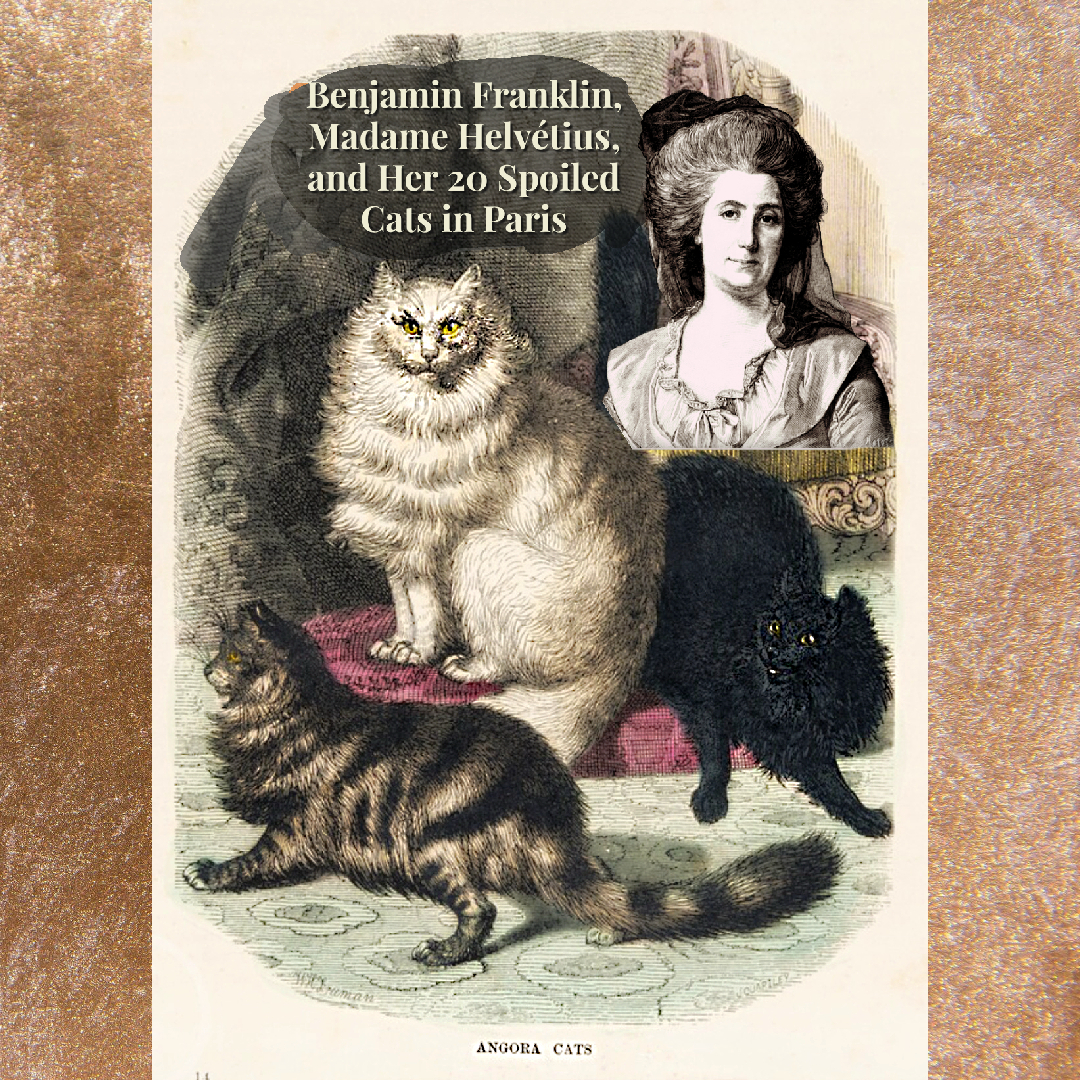
Living in 18th-century France, Madame Helvétius surrounded herself not only with philosophers, intellectuals, and political thinkers, like Benjamin Franklin…
but also with chickens, pigeons, canaries, lapdogs, and no fewer than twenty Angora cats.
Yes. Twenty.
And apparently these were not ordinary cats.
From September through June, many of them reportedly wore embroidered satin jackets lined with fur to keep warm. Honestly, I’m trying to imagine the logistics of dressing twenty fluffy Angoras in tiny formal coats and can only conclude that at least a few highly opinionated cats were involved in the negotiations.
Sadly, no paintings of these magnificently dressed creatures seem to survive.
We do, however, know some of their names:
- Aza
- Le Noir
- Courtois
- Musette
- Pompon
And Pompon, it seems, was the undisputed favorite.
Benjamin Franklin himself joked that Madame denied him her evening company because she spent her nights exclusively with Pompon curled beside her. Franklin, understandably, took second place.
The Cats of Auteuil Ruled the Gardens
But the cats did not merely rule Madame Helvétius’s drawing room.
They also ruled the sprawling, slightly wild two-acre gardens at Auteuil.
The estate became an extension of their kingdom. Garden benches, terraces, woodyards, kitchen rooftops, sunny pathways, and outdoor lounges all fell firmly under feline occupation. Visitors quickly discovered that entering Madame Helvétius’s world meant navigating not only philosophers and aristocrats, but a semi-feral aristocracy of extremely well-fed Angora cats.
The outdoor spaces at Auteuil were almost as famous as the salon itself.
Madame Helvétius adored animals and regularly fed enormous numbers of birds throughout the gardens during the winter months. Pigeons, canaries, blackbirds, sparrows, and chickens wandered freely through the estate while philosophers debated politics and Enlightenment ideals beneath the trees.
And somehow, the cats coexisted with all of it.
Visitors noted with amusement that the Angoras were often far too pampered, and frankly too full of cream and table scraps, to bother hunting.
Birds fluttered safely nearby while the cats lounged dramatically in the grass or sprawled across sunny benches like powdered aristocrats recovering from an exhausting social season.
Honestly, some things about cat ownership never change.
A Drawing Room Ruled by Cats
One of the most entertaining surviving accounts comes from a dinner party anecdote that circulated around Paris in 1785.
According to the Baron d’Andlau, visiting Madame Helvétius was less like entering a salon and more like stepping into a feline monarchy.
He described arriving at her beautifully decorated home only to discover every chair occupied by elaborately dressed Angora cats lounging like aristocrats.
Madame attempted to greet her guests while simultaneously disciplining cats, speaking to servants, and monitoring feline politics in real time:
“Gentlemen, I am very happy to see you. What are you doing there, Courtois? You are annoying Marquise. Come off that chair!”
A moment later:
“What lovely weather this is. Not there, stupid! Don’t you see Musette and her kittens will spring at you?”
Meanwhile, the guests stood awkwardly in the middle of the room, unable to find a clean place to sit while satin-robed cats paraded around with what the Baron described as “great dignity.”
Apparently this territorial behavior extended outdoors as well.
Guests complained that finding a place to sit in the gardens could become a diplomatic negotiation, since the warmest benches and sunniest corners were usually occupied by enormous white Angoras who regarded the estate furniture as their ancestral property.
One imagines Enlightenment thinkers carefully relocating fluffy cats before discussing revolution, liberty, and the rights of man.
Then came dinner.
Servants entered carrying trays of delicate meats, chicken, wild fowl, and other delicacies, all intended for the cats. Predictably, complete chaos erupted.
The Baron later admitted he feared leaving the house with poultry grease and dangling chicken wings attached to his coat after navigating the feline banquet.
And frankly, that also feels timeless.
The Woodyard Population Explosion
The cats multiplied sadly no spay/neuter then)so enthusiastically throughout the woodyard and back gardens that their population became something of a running joke among Madame Helvétius’s intellectual circle.
Benjamin Franklin himself jokingly connected the feline explosion to his own theories about population growth and abundance. According to Franklin, unlimited food and comfort naturally resulted in the cats steadily overtaking the estate.
In other words, give cats unlimited cream, fireplaces, satin coats, philosophical admiration, and complete freedom to roam the gardens, and they will inevitably colonize the landscape.
The woodyard became particularly notorious. The cats apparently spent enormous amounts of time there, producing generation after generation of fluffy descendants while living what was essentially the feline equivalent of aristocratic luxury.
Which eventually led to one of the strangest and most charming pieces of cat literature ever written.
The Cats Hire Legal Counsel
The abbé Morellet, one of the household’s regular intellectuals and visitors, wrote a mock legal petition entirely from the perspective of the cats themselves.
Yes. The cats hired legal counsel.
The premise was simple.
The humans had become scandalized by several alleged feline offenses:
- chickens disappearing
- pigeons vanishing
- canaries being stalked
- nightingales allegedly eaten
- mice multiplying instead of decreasing
The proposed solution?
Drowning the excess cats.
Naturally, the cats objected.
Their petition begins dramatically:
“A terrible piece of news has just reached us… we are all to be seized, put into a cask, rolled down to the river, and abandoned to the mercy of the waters.”
The cats then proceed to defend themselves with remarkable Enlightenment-era logic.
Their central argument is essentially this:
Where is the evidence?
They point out that well-fed cats have no reason to commit crimes:
“Great crimes are the consequences of great misery and want… nothing is wanting to us.”
Honestly, this may be the earliest recorded version of:
“I already have premium food and emotional support. Why would I steal your chicken?”
The Defense of the Chickens, Pigeons, and Songbirds
The cats argue that humans are far more suspicious than felines when it comes to missing poultry.
After all, hundreds of chickens passed through local taverns every Sunday. Perhaps, they suggest delicately, humans were the true thieves.
The cats also make the excellent point that unchecked chicken reproduction would eventually overrun the estate:
“Your whole house [would become] a receptacle for chickens.”
The pigeon accusations are dismissed with equal theatricality. If pigeons disappeared, perhaps they simply fled in search of political equality elsewhere:
“They have taken flight in search of equality to some republican dove-cote.”
As for the canaries, the cats insist the aviary lattice was too narrow for paws to pass through.
And the nightingales?
The cats plead ignorance.
Apparently they could not distinguish between sparrows and prized songbirds because, as one cat allegedly explained:
“They who only know how to mew cannot be judges of the art of singing.”
This entire section reads like courtroom drama written by extremely articulate housecats.
The Mouse Problem
Perhaps my favorite section concerns the mice.
The cats are accused of allowing mice to overrun the house, eating sweets, damaging books, and nibbling slippers.
The cats respond by accusing the humans of hypocrisy.
One resident, Cabanis, is described as consuming so many sweets that the cats imply he has more in common with the mice than with civilized society.
And as for the damaged books?
The cats politely suggest the books may not be especially useful anyway.
They praise Madame Helvétius for being naturally happy, charming, and good-hearted without needing intellectual treatises to explain life to her.
Honestly, it’s a surprisingly modern observation.
“We Live Under the Reign of a DOG”
The emotional climax of the petition comes near the end.
The cats mourn the death of Pompon and complain bitterly about the rise of canine influence within the household:
“Those happy times are no more… We live under the reign of a DOG.”
The English bulldog, they insist, terrorizes French cats specifically. Poor Le Noir even loses part of his tail.
Meanwhile, the cats nostalgically remember the golden age when Pompon ruled the household from Madame’s lap and occasionally shared royal rabbits sent from the king’s hunting parties.
And then comes the final image, which is unexpectedly touching:
“Our only consolation is to go every night, and water with our tears the cypress which shadows his tomb.”
Underneath all the satire and absurdity, there’s something strangely tender here.
The gardens themselves became central to the mythology surrounding the cats. In Morellet’s satirical petition, the cats specifically defend their right to roam freely through the woodyard, rooftops, terraces, and outdoor grounds of Auteuil. Their attachment to the estate is treated almost as a political right, less household pet than tiny furry citizen of a feline republic.
And honestly, the cats would probably agree.
For all the exaggeration, these stories reveal something enduring about humans and cats. We have always projected personality, politics, humor, emotional meaning, and even philosophy onto them. They become family members, confidants, tiny monarchs, household spirits, and occasionally furry legal scholars defending themselves against accusations of poultry theft.
And frankly?
Given the evidence, I’m inclined to believe the cats.
Sources & Further Reading
- Benjamin Franklin in Paris by Claude-Anne Lopez
- Memoirs of Baroness d’Oberkirch
- Historical writings of Abbé Morellet
- Letters and writings connected to Benjamin Franklin’s years in France
- French Lessons for American Cats in Paris