Trainer Picks & Buying Guide
⏱ Estimated reading time: 14 min read
There is an enormous difference between a good leather dog collar and a collar that happens to be made from leather.
And price doesn’t necessarily tell you which one you’re looking at.
When I assess a collar, I’m looking at the leather itself, but I’m also looking at the hardware holding it together, how the collar distributes pressure, how much adjustment it gives me, what sits against the dog’s neck, how it is going to age, and — importantly — whether leather is even the right material for that particular dog.
Because sometimes it isn’t.
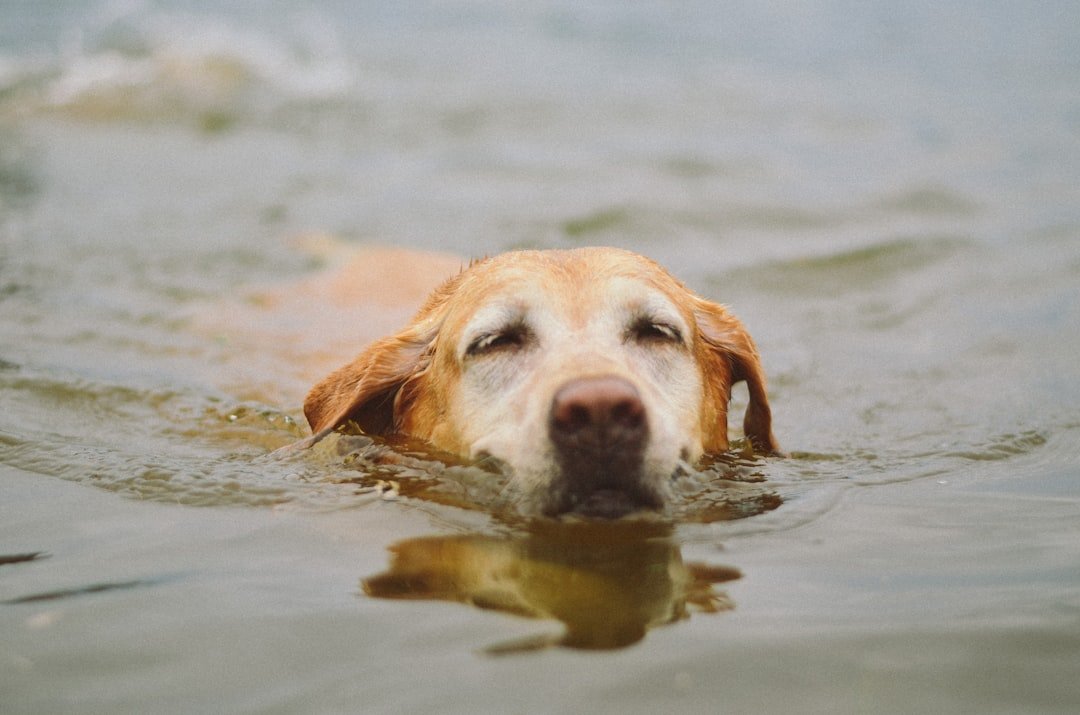
A beautiful vegetable-tanned leather collar makes considerably less sense on a Labrador who swims six days a week than it does on an adult dog with a stable neck measurement whose owner wants something that will soften, age and potentially last for years.
So rather than declaring one leather collar universally “best”, these are the collars I think make sense for different dogs and different jobs — and what I actually look for before recommending one.
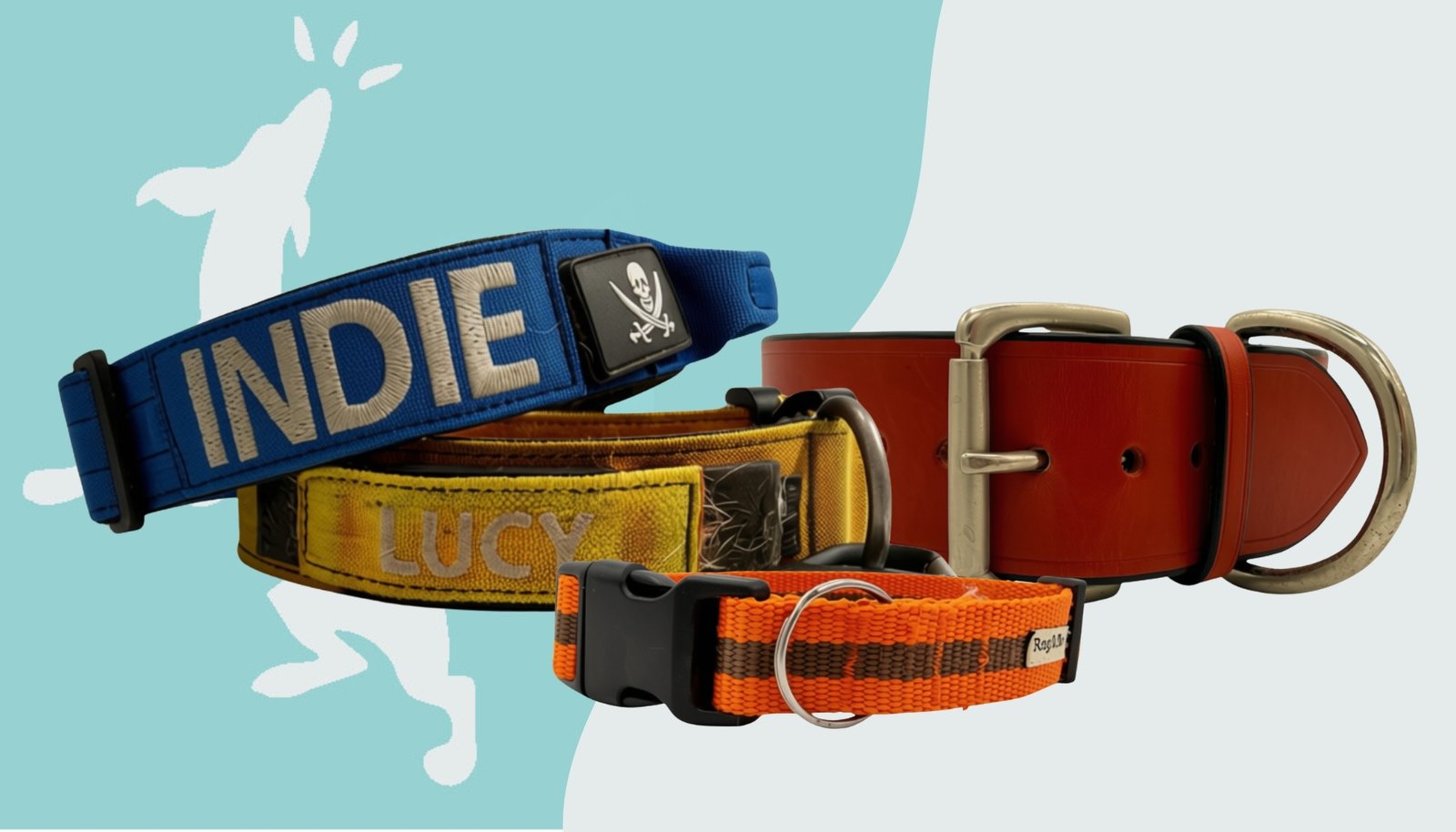
The best leather dog collars at a glance
Best traditional leather collar: The Lille Björn Vero Classic
Best broad padded leather collar: Ray Allen Ultimate Padded Leather Agitation Collar
Best everyday padded leather collar: Soft Touch Collars Leather Two-Tone
Best rolled leather collar: Auburn Leathercrafters Rolled Collar
Best leather collar for Greyhounds and sighthounds: Pear Tannery Super Soft Padded Greyhound Collar
Best luxury statement collar: Crazy Rebels
Best vegan alternative to leather: BUMAS BioThane Collar
Best traditional leather dog collar: The Lille Björn Vero Classic
If I’m looking for a traditional leather collar, I want the quality to come from the materials and construction rather than decoration.
The Vero Classic from The Lille Björn is a particularly good example of that approach.
It’s made from a single 3mm piece of full-grain Italian vegetable-tanned leather. There are no bonded leather layers, no glue laminating layers of leather together and no stitched seam running the length of the strap. The buckle, D-ring and Chicago rivets are solid brass.
Those are useful specifications because they tell me where the money has gone.
“Luxury” tells me nothing. Full-grain leather, 3mm thickness and solid brass are things I can actually assess.
The Vero comes in 2cm and 3cm widths and six sizes from XXS to XL, covering necks from 17cm to 47cm. Each individual size has around 5cm of adjustment.
That relatively modest adjustment range is worth understanding. This isn’t a collar I’d buy deliberately oversized for a rapidly growing puppy and hope to adjust for the next year. For an adult dog whose neck size is relatively stable, that matters much less.
It’s also made from vegetable-tanned leather, and that means accepting what comes with owning traditional leather.
The collar begins relatively firm, then softens and starts moulding to the dog’s neck with wear. Both the leather and brass develop a patina rather than remaining pristine.
I actually like that. A good traditional leather collar should look better at three years old than a cheap one looks after three months.
But leather needs care. This isn’t the collar I’d choose for a dog who spends half its life in a lake. Repeated soaking isn’t ideal for vegetable-tanned leather, and it benefits from occasional conditioning.
At $69–75, the Vero isn’t inexpensive. What makes the price make sense is that you can actually identify what you’re paying for: substantial full-grain leather, solid hardware, made-to-order construction and hand finishing.
What I like
The materials are unusually straightforward. There aren’t lots of decorative layers concealing what the collar is actually made from, and solid brass is a meaningful upgrade over inexpensive plated hardware.
I also like the debossed personalisation. A name or initials can be pressed directly into the leather rather than adding another plate or dangling piece of hardware against the neck.
What I don’t
The adjustment range means measuring properly matters, and leather maintenance is considerably more involved than throwing a nylon collar into the wash.
It is also quite simply more collar than a growing puppy needs.
Best for: adult dogs whose owners want a traditional, understated leather collar designed to age rather than be routinely replaced.
Best broad padded leather dog collar: Ray Allen Ultimate Padded Leather Agitation Collar
This is a completely different animal.
Ray Allen’s Ultimate Padded Leather Agitation Collar is made from latigo leather with a breathable neoprene lining and comes in either 1.5-inch or 2-inch widths. There are 20-inch and 24-inch lengths, with an optional handle.
That immediately tells you who this collar isn’t for.
I’m not putting a two-inch agitation collar on a little Spaniel because “wide collars distribute pressure better”. Width has to be proportional to the dog.
For a substantial working dog, though, broad collars have a legitimate function. Increasing the contact area distributes tension across more of the neck, and Ray Allen specifically designs this collar for tracking, agitation and working applications as well as everyday use. The inner neoprene padding is intended to reduce irritation and the company says it doesn’t collect dog hair.
If you’re searching for the best durable dog collars for highly active dogs, this is the sort of product where I’d start looking — but with an important qualification.
A heavy-duty collar is not a solution for a dog that spends its walks hauling into the leash. For ordinary pet dogs that pull, I’d rather address the walking setup and training than simply put a broader, stronger collar around the neck.
This is specialist equipment and should be judged as such.
Best for: larger working dogs and handlers who specifically need a broad, substantial padded leather collar.
Best everyday padded leather collar: Soft Touch Collars Leather Two-Tone
Not everyone wants to spend months breaking in a firm traditional leather collar.
For owners who want leather with softness from the beginning, the Soft Touch Collars Leather Two-Tone takes a different approach.
The outer collar is full-grain leather, while the inside is lined with soft sheepskin leather. It also uses solid brass hardware.
That lining is the big distinction here.
Padding can add bulk, but it can also make a collar considerably more forgiving against the neck, particularly for dogs with short coats where there’s very little fur providing a buffer between collar and skin.
It makes this a nice example of why “best leather collar” isn’t a single specification.
The Vero’s unlined single-piece construction appeals to me because of its simplicity and the way it should mould with age. The Soft Touch takes the opposite approach and prioritises immediate softness.
Neither philosophy is automatically better.
Best for: owners who like traditional leather aesthetics but want a softer padded feel from day one.
Best rolled leather dog collar: Auburn Leathercrafters Rolled Collar
Sometimes the most important thing about a collar isn’t strength or padding.
It’s the coat underneath it.
Flat collars can rub against longer coats and contribute to matting or that distinctive ridge of hair around the neck. A rolled collar drastically reduces the amount of material sitting flat against the coat.
Auburn Leathercrafters’ Rolled Collar is specifically designed to help prevent fur from matting, with hand-polished edges and sizes running from toy breeds through to large dogs.
That makes it a particularly interesting choice for dogs such as Collies and Spaniels where preserving coat condition matters.
There is a trade-off.
A rolled collar concentrates force over a narrower contact area than a broad flat collar, so it would not be my preferred walking equipment for a dog that pulls hard.
For carrying ID and normal everyday collar wear on an appropriate dog, though, rolled leather solves a real problem.
Best for: long-coated dogs whose flat collars contribute to matting or coat damage.
Best leather collar for Greyhounds and sighthounds: Pear Tannery Super Soft Padded Greyhound Collar
Sighthounds deserve their own category because their anatomy changes what I want from a collar.
Greyhounds, Whippets and Lurchers typically have long, fine necks and relatively narrow heads. Putting a standard narrow collar around that anatomy isn’t necessarily the best answer.
The Pear Tannery Super Soft Padded Greyhound Collar is specifically shaped for Greyhounds, Whippets, Lurchers and other long-necked breeds. It uses European vegetable-tanned full-grain leather with a neoprene layer covered in soft leather, giving the collar a broad, padded contact area against the neck.
This is where breed-specific design actually means something.
It isn’t a generic collar with a Greyhound printed on the packaging. The proportions of the collar have been changed because the proportions of the dog are different.
One caveat: sighthounds can also be exceptionally good at reversing out of collars. For dogs where escape risk is a concern, I’d still consider whether a correctly fitted martingale or other secure walking setup is more appropriate than relying on a buckle collar alone.
But as a broad leather collar designed around sighthound anatomy, this one makes sense.
Best for: Greyhounds, Whippets, Lurchers and similarly built dogs needing a broad, softly padded leather collar.
Best luxury statement leather collar: Crazy Rebels
And then there are collars that exist partly because they’re gorgeous.
That’s allowed.
Dog equipment doesn’t have to pretend aesthetics don’t matter.
Crazy Rebels sits firmly in statement-collar territory, with highly customised leather pieces offering choices in colour, width, hardware, decoration and design.
This is very different from The Lille Björn’s minimalist approach.
Crazy Rebels is jewellery.
And I don’t mean that dismissively.
If somebody wants a beautifully made collar that is part functional equipment and part ridiculous dog wardrobe — I understand the assignment.
What I wouldn’t do is confuse decoration with quality. With statement collars, I still want to know what’s underneath everything: the base leather, the hardware, the construction and the fit.
Best for: the dog whose owner absolutely believes the collar is the outfit.
Best vegan alternative to leather: BUMAS BioThane Collar
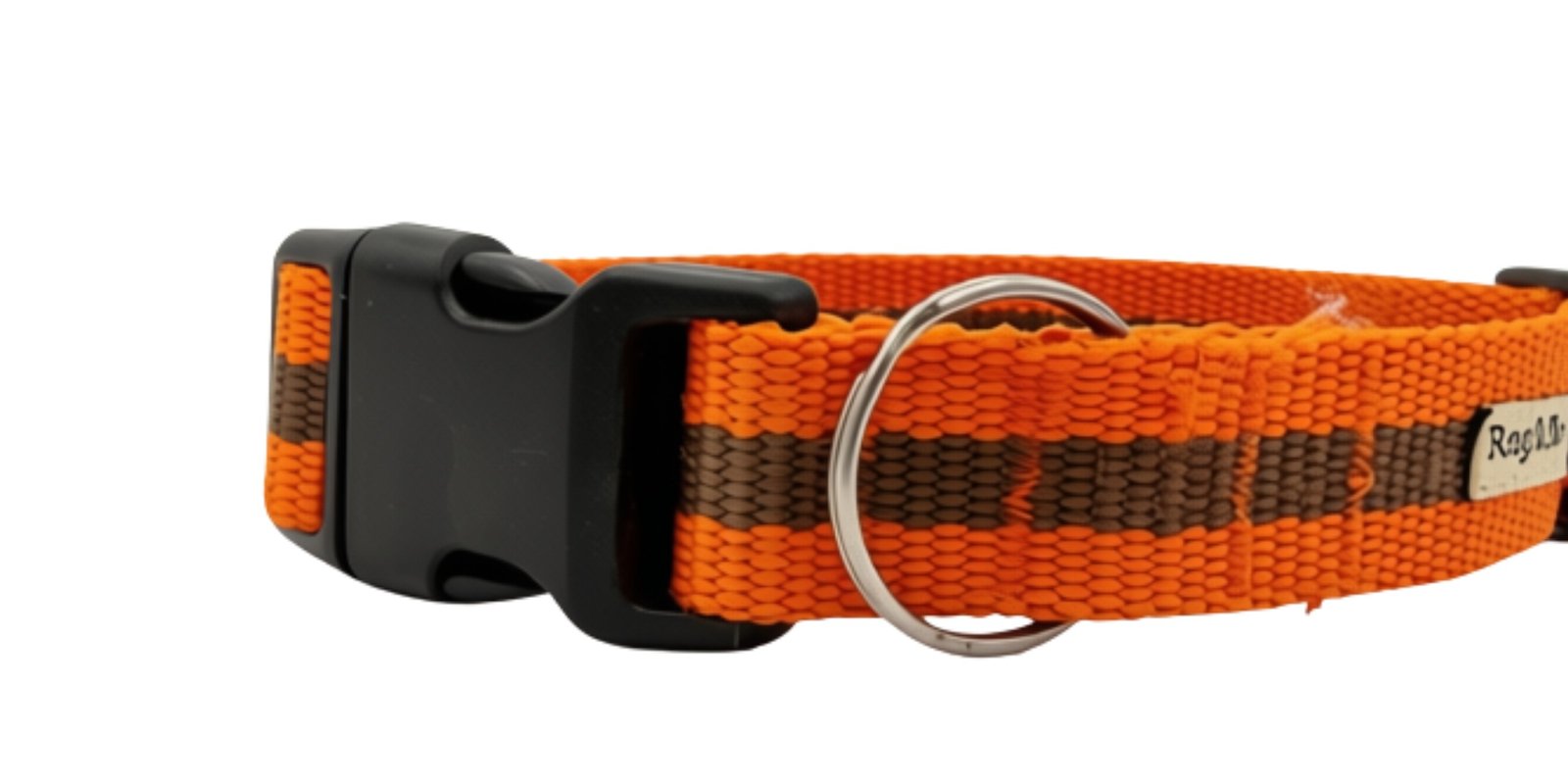
And if you’ve reached this point thinking, “All of this sounds lovely, but my dog swims in mud,” I have good news.
You probably don’t need leather.
BioThane is one of my favourite examples of choosing material according to lifestyle rather than prestige.
BUMAS makes made-to-measure BioThane collars, and BioThane’s big practical advantage is water resistance. It can be rinsed or wiped clean, doesn’t require leather conditioning and is particularly useful around rain, snow and swimming.
For some dogs, that’s simply better.
A high-quality leather collar may age beautifully over ten years. That’s irrelevant if owning it irritates you because you’re constantly trying to dry and condition the thing after your Labrador has discovered another stagnant pond.
BioThane gives you much of the clean, structured appearance people like about leather with radically less maintenance.
And for owners avoiding animal-derived materials, it provides an obvious alternative without having to buy something marketed misleadingly as “vegan leather”.
Best for: swimmers, mud enthusiasts, low-maintenance households and owners looking for a non-leather alternative.
How to identify a high-quality leather dog collar
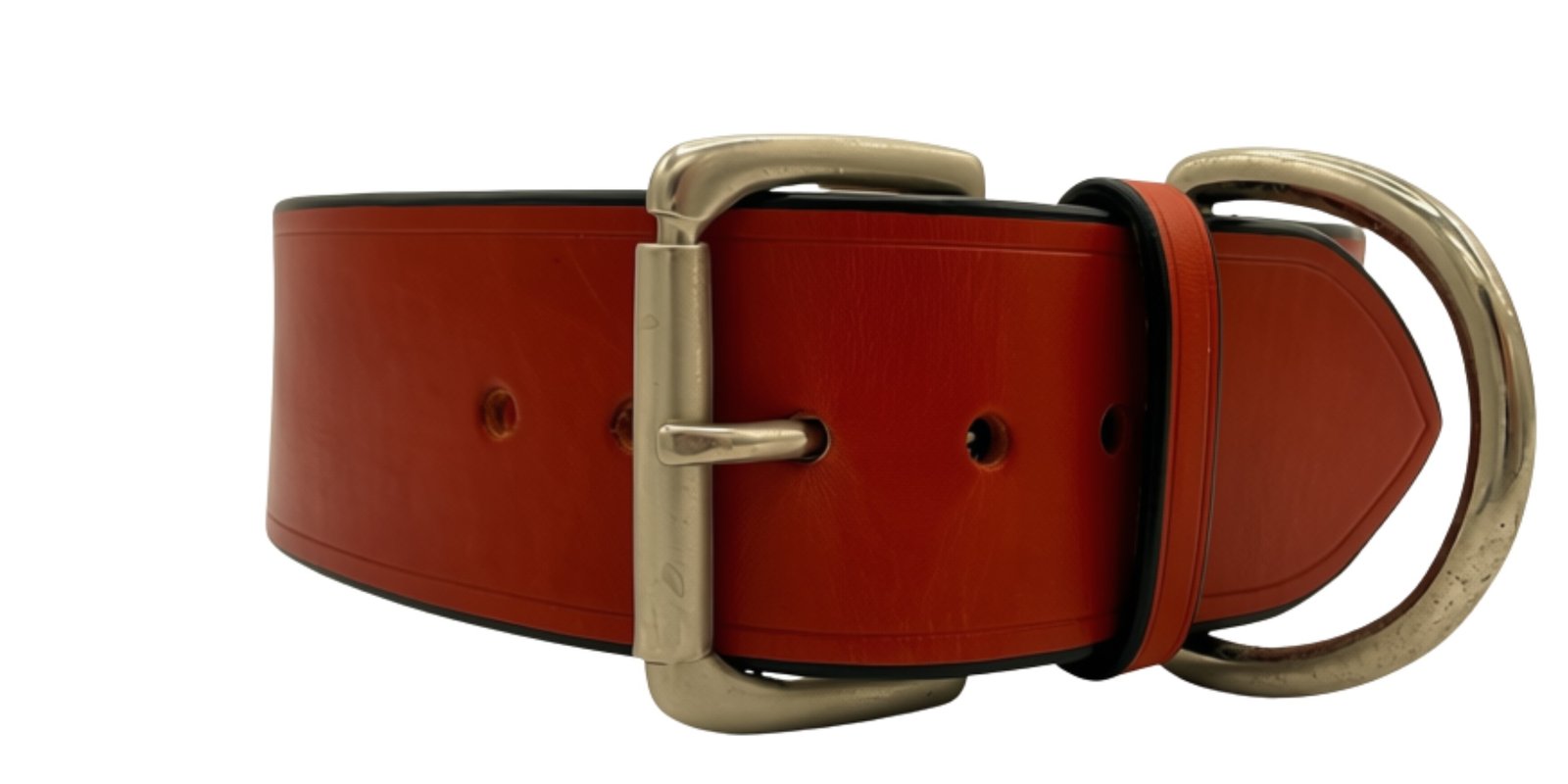
Once you stop looking at brands, there are a few things that matter consistently.
1. Know what leather you’re buying
“Genuine leather” is not the quality guarantee many people assume it is.
I want manufacturers to tell me exactly what they’re using.
Full-grain leather retains the natural grain of the hide and is generally what I’m looking for in a traditional collar intended to develop character and last.
I also want to know whether I’m looking at one substantial piece of leather, a deliberately constructed multi-layer collar, or cheaper material bonded together.
Those are very different products.
2. Look at the hardware
The strap isn’t the only component carrying load.
Look at the buckle. Look at the D-ring. Look at how that D-ring is attached to the collar.
With an everyday walking collar, those connection points matter enormously.
This is one reason the Vero Classic’s solid brass buckle, D-ring and rivets caught my attention. The specification is telling you exactly what the hardware is made from rather than simply describing it as “premium”.
3. Think about width in relation to the dog
Wider is not automatically better.
A broad collar provides a larger contact area, but it also adds bulk and can interfere with comfortable movement if you put too much collar on too little dog.
Conversely, a very narrow collar isn’t what I want taking substantial leash tension on a large dog.
Proportion matters.
4. Fit the dog in front of you
Please don’t buy collars by breed. If you’re unsure where a collar should sit or how snug it should be, my dog collar fit and safety guide covers the basics.
I’ve met dogs of the same breed whose neck measurements differ by inches.
Measure around the neck where the collar will actually sit and follow the manufacturer’s own sizing instructions.
And if your dog is still growing rapidly, don’t spend a fortune on something with two inches of total adjustment unless you’re quite happy to buy another one.
5. Decide how much maintenance you’re prepared to do
This is possibly the least glamorous criterion and one of the most important.
Good leather needs looking after.
If it becomes wet, let it dry naturally rather than baking it beside a radiator. Keep it clean. Condition it when necessary. Inspect areas that flex repeatedly and check around the hardware.
If reading that already annoys you, buy BioThane or nylon.
Seriously.
The best collar is not the theoretically most beautiful material. It’s the one you can maintain appropriately for the life you and your dog actually lead.
Are high-quality leather dog collars worth the investment?
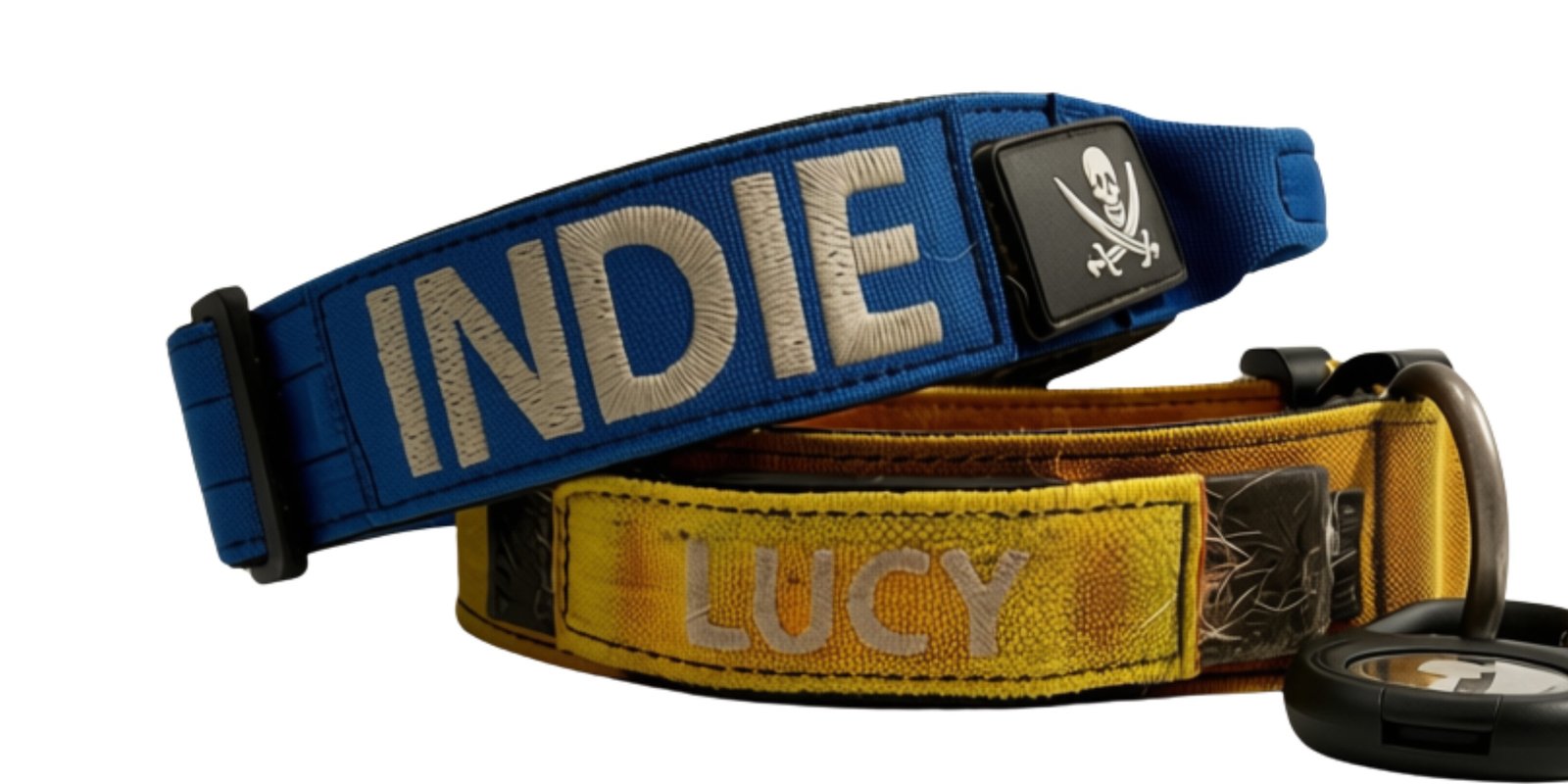
They can be.
But I wouldn’t make the argument that buying an expensive leather collar automatically saves money over nylon.
There are too many variables for that.
A $15 nylon collar can last an extremely long time on one dog. A $100 leather collar can be destroyed remarkably quickly by another dog’s teeth, water exposure or neglect.
The better argument for premium leather is that you’re paying for a particular combination of material, construction, feel, appearance and ageing.
That’s why I find products such as The Lille Björn Vero Classic more convincing when they’re described through their construction rather than through luxury language.
Three-millimetre full-grain vegetable-tanned leather. A single-piece strap. Solid brass hardware. Handmade, made-to-order production.
Now I can decide whether those features are worth $69–75 to me.
That’s useful.
“Premium dog collar” isn’t.
Which dog collars are best for everyday walking?
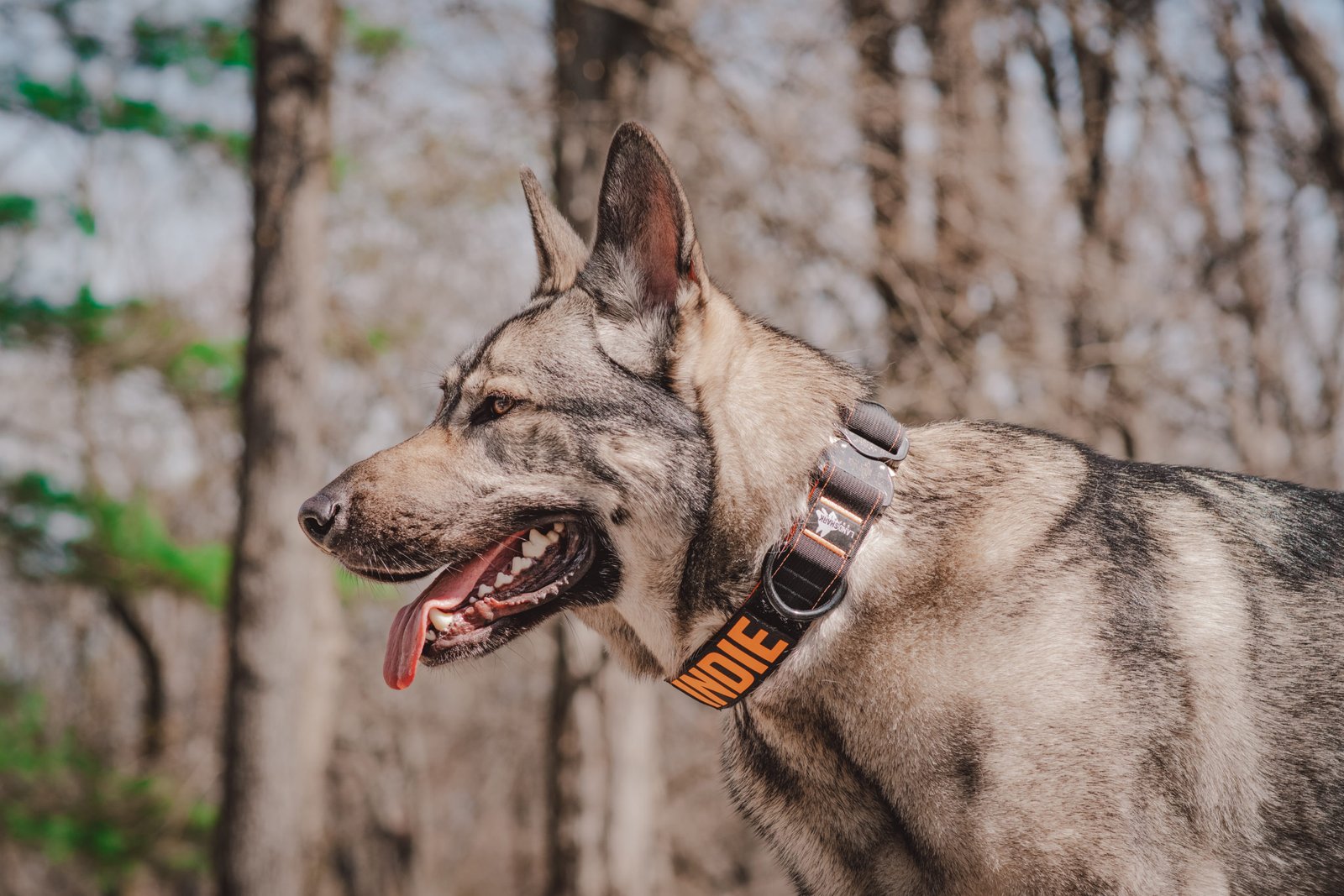
For most dogs, the best collar for everyday walking is one that fits correctly, doesn’t interfere with normal movement, uses dependable hardware and suits both the dog’s behaviour and the way the owner actually lives.
That might be leather.
It might be nylon.
It might be BioThane.
And for dogs that pull significantly, I may not want the collar to be the primary point of leash attachment at all.
A collar is one piece of equipment. It doesn’t need to solve every problem.
If I wanted a stylish, durable collar for an adult dog and I liked the feel and ageing of traditional leather, I’d look closely at something constructed like the Vero Classic.
If my dog had a coat prone to matting, I’d look at rolled leather.
If I had a Greyhound, I’d be thinking about sighthound anatomy.
If I had a working dog requiring a substantial broad collar, Ray Allen makes far more sense.
And if I had a water-obsessed dog who considers clean equipment a personal insult, I’d probably buy the BUMAS and enjoy not owning leather conditioner.
That, ultimately, is what I actually look for in a dog collar.
Not the biggest price tag.
Not the prettiest marketing.
And definitely not the word “luxury”.
I want to be able to see what the collar does well, understand what compromises come with it, and match those qualities to the dog wearing it.
Because the best leather dog collar isn’t necessarily the most expensive one.
It’s the one that makes sense for your dog.