14 epic things to do in Beijing for cat lovers: palaces, cafés, Great Wall day trips, and more
⏱ Estimated reading time: 22 min read
Last Updated on 20 February 2026 by Vanessa
Beijing can quickly feel overwhelming if you’re just following a typical sightseeing itinerary. Palaces, markets, temples—there’s a lot to see. But if you’re looking for unique things to do in Beijing, especially as a cat lover, the city reveals a completely different side.
Beyond imperial architecture and Great Wall views, Beijing is home to:
- Palace cats living inside historic complexes
- Cat cafés tucked into hutongs
- Stray colonies lounging in royal parks
- Cat murals and sculptures hidden in creative districts
- Mountain villages where cats roam beneath the Great Wall
I’ve put together a guide with 14 epic cat-focused experiences in Beijing. Some are well-known cat cafés, others are tucked-away guesthouses or historic parks. Each entry includes practical details like addresses, how to get there, ticket and booking options, and more.
If you love travel and cats, this is how to explore Beijing properly.

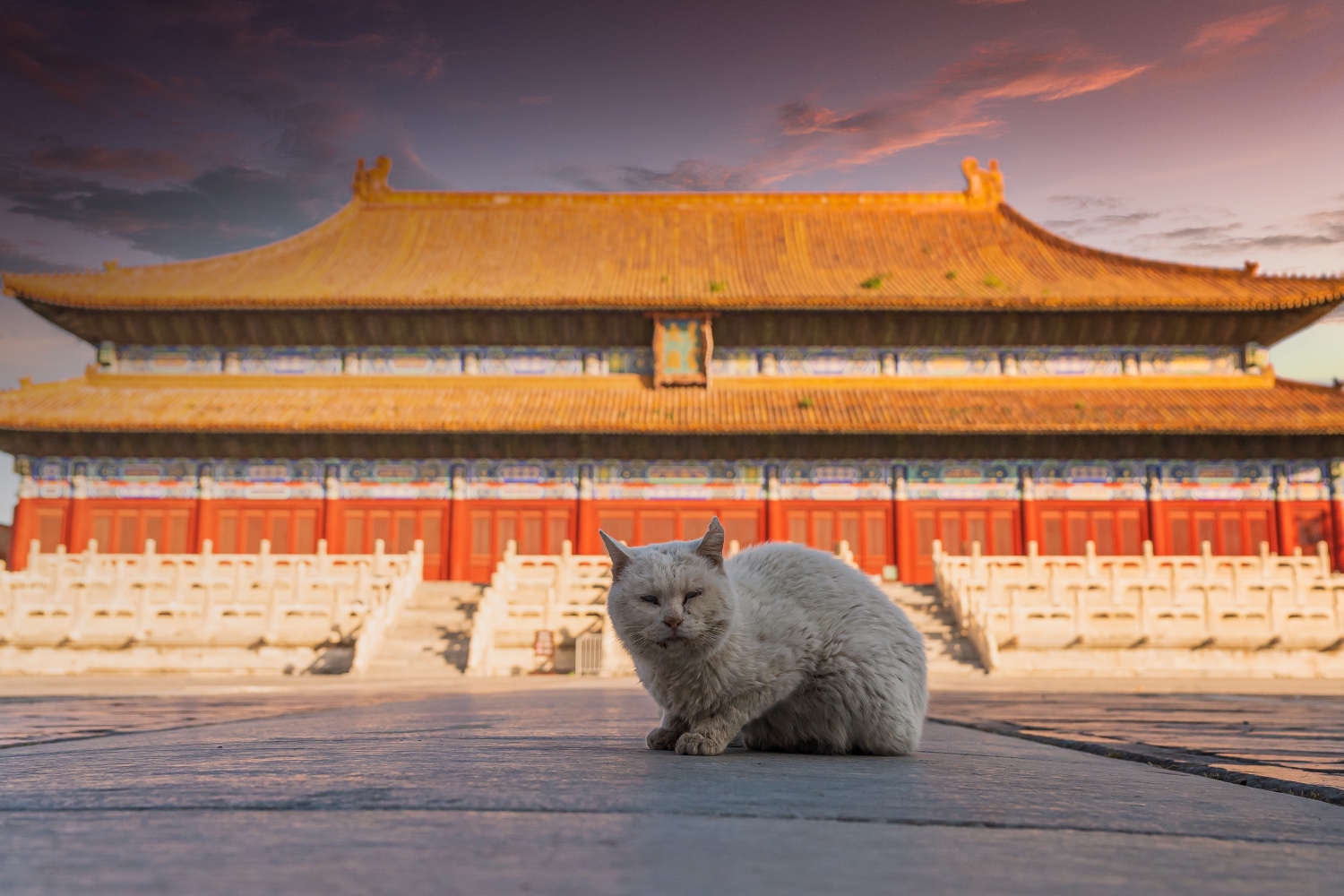
Spot the 150+ palace cats at Beijing’s Forbidden City
Let’s be honest: you’re probably visiting the Forbidden City anyway. It’s one of those you can’t come to Beijing and skip it places. But if you’re a cat lover, there’s an extra layer to the experience that most tourist guides don’t talk about—the Forbidden City cats.
The complex is home to a managed colony of around 150–200 feral cats. During the Ming and Qing dynasties, the palace originally kept them to control rodents, and today museum staff continue to care for them. Local animal welfare groups monitor the cats, and the Palace Museum even features them on official merchandise.
How long do you need to visit Forbidden City?
It usually takes around three hours to visit Forbidden City. This gives you enough time to walk the main central axis, explore a few side courtyards, and soak in the scale of the palace complex.
If you move quickly and focus only on the highlights, you can finish in around two hours.
But if you enjoy reading exhibits, visiting smaller halls, or lingering in quieter corners (especially if you’re hoping to spend some time with the palace cats), you could easily spend four hours or more.
Where is Forbidden City?
Address: Forbidden City, 4 Jingshan Front Street, Dongcheng District, Beijing, china.
How to get there?
The Forbidden City is located right in the heart of Beijing, just north of Tian’anmen Square. To get there, you can take:
- Metro: Line 1 to Tian’anmen East or Tian’anmen West, then walk about 10 minutes.
- Bus: Several buses stop near Tian’anmen Square.
- On foot: Easy walk from Wangfujing or Jingshan Park.
Best time to visit
- Right when it opens is hands down the best time.
- Spring and autumn are ideal, because then the cats are more active and the weather is comfortable.
- Winter is surprisingly great, too, if you don’t mind the cold; fewer crowds and very photogenic cats.
Tickets & guided visits
You must book tickets in advance. Also, they often sell out—especially on weekends and holidays. So don’t wait, You can get your tickets to Forbidden City here.
If you want a smoother experience and better chances of seeing more cats, I recommend booking a guide as well (this is optional when you buy your entry ticket). Guides know how to avoid the worst crowds and where the cats tend the hang out.
Look for stray cats in Beihai Park
I like busy cities, but I don’t like feeling rushed all the time. Beijing can feel intense, especially if you stack major sights back to back. That’s why I always recommend setting aside time for Beihai Park. It gives you space to slow down without leaving the city.
Beihai Park sits right in central Beijing, yet it feels removed from traffic and noise almost immediately. Wide paths, open water, and old trees shape the pace here.
Many stray cats live at Beihai Park, and they clearly know the best napping spots. You’ll often see them stretched out along the leafy paths, hanging around historic pavilions, or watching tourists from a safe (and judgmental) distance. It’s not a cat attraction in the traditional sense, but that somehow makes it even better.
How long do you need in Beihai Park?
You’ll want about one and a half to two hours in Beihai Park. This is enough time to stroll the lakeside paths, climb up to the White Dagoba for panoramic views over central Beijing, wander through quiet pavilions, and slow down a bit after busier sightseeing.
Where is Belhai Park?
Beihai Park, 1 Wenjin Street, Xicheng District, Beijing, China.
How to get there
Beihai Park is located in central Beijing, west of the Forbidden City and close to Jingshan Park. You can get there by:
- Metro: Line 6 to Beihai North, Exit B, then walk about 5 minutes.
- Bus: Multiple buses stop near the south and east gates.
- Walking: Easy to combine with the Forbidden City or Shichahai.
Best time to visit
- Morning or late afternoon is best for spotting cats.
- Spring and autumn are perfect, but summer evenings can be lovely too.
- Weekdays are quieter and feel more local.
Tickets
Beihai Park has a small entrance fee, but lines can form during busy hours. Booking your Beihai Park ticket online saves time and makes it easier to slot the park into a packed sightseeing day. Some ticket options include seasonal extras like boat rides, which is a nice bonus if you’re already there.
Relax with resident cats at Beijing’s best cat cafés
There are around a dozen well-known cafés where cats roam freely, and each has its own vibe. In Dongcheng, you’ll find spots like World’s End Girlfriend Cat Café and Cat Yard, cozy cafés tucked in hutongs where cats lounge on the sofas.
Near Nanluoguxiang, Cat Planet and Meow Town Café combine drinks with a few friendly resident cats. Out in Chaoyang, cafés like Maan Cat Coffee and Cappucimeow Cat Café offer more spacious interiors with multiple cats to interact with.
Visiting a cat café in Beijing works well for a short break or an afternoon stop between sightseeing. Some cafés serve tea and snacks while others offer light meals as well. In any case, they’re all perfect for slowing down after walking through busy markets or historic streets.
💡 Pro tip: Pick a cat café that acts as a foster home for adoptable rescue cats. That way, the cost of your visit and drink will go directly to caring for these cats. It’ll be your good deed of the day.
Meet the shop cats of the hutong neighborhoods inside the 2nd Ring Road
This is the heart of old Beijing. Narrow lanes, courtyard houses, small family-run shops, and long-term residents who’ve lived there for decades. You’ll see elderly people sitting outside, playing cards, fixing bikes, chatting, or watching the street go by.
Cats are everywhere here, just as part of daily life. You’ll notice that many shops here have resident cats as well. There’s even a book about them: Shop Cats of China by Marcel Heijnen, which is an absolute must if it’s not already in your collection.
Best time to visit
Many of these family-run places unlock their doors between 07:00 and 09:00 am. Breakfast spots, steamed bun windows, tofu sellers, and small grocery shops often start even earlier, sometimes around 06:30 – 07:00 am. This is when elderly locals do their daily shopping, and when cats tend to hang around entrances waiting for scraps or attention.
From about 09:30 am to noon, the pace slows down. This is one of the best times to wander hutongs if you want to see cats lounging on counters, doorsteps, and delivery scooters without rushing crowds.
Don’t visit too late, though. Most traditional shops close surprisingly early, usually between 05:00 and 07:00 pm.
Spot the “Palace Cat” at Baita Temple in Beijing
Near the entrance of the historic Baita Temple or White Pagoda Temple in Xicheng District, there’s a sculpture of a chubby orange cat wearing a red scarf. People call it the Palace Cat, and it’s become a quiet landmark for anyone wandering the temple grounds. Many tourists use it as a meeting point before exploring nearby paths, gardens, and temple buildings.
The temple itself is a Qing dynasty landmark built in 1651 to honor the visit of the 5th Dalai Lama. It is home to the 36-meter White Pagoda, a unique mix of Tibetan and Han architecture.
Where is Baita Temple (Baita Si)?
Baita Temple (Baita Si), 171 Funei Ave, Xicheng District, Beijing, China.
How to get there
Baita Temple sits in Xicheng District, just north of Shichahai and not far from the scenic hutong neighborhoods. The area combines the quiet charm of old Beijing with easy access to central sights. The closest subway station is Shichahai Station on Line 8. From there, it’s a short walk north through the hutong area toward the temple.
Best time to visit
Mornings and early afternoons work best if you want fewer crowds and softer light for photos. Spring and autumn bring pleasant temperatures to walk around the temple and nearby parks, while winter feels quieter and more reflective if you don’t mind the cold.
Evening visits feel calm too, since the area around Shichahai and the hutongs quiets down after sunset.
Tickets
You don’t need a ticket if you only want to see the Palace Cat sculpture. Anyone walking past the Baita Temple grounds can see the chubby orange cat in its red scarf.
However, you do need a ticket to enter the Baita Temple itself. There is a small admission fee of ¥20 per person, and you can buy this ticket on site at the entrance ticket counter.
Meet the strays of Chaoyang Park
Many locals treat Chaoyang Park in central Beijing like a shared backyard. Morning tai chi, lunchtime walks, and children on scooters are very common here.
Spanning nearly 290 hectares, it’s the city’s largest urban park and even a former venue for the 2008 Olympic beach volleyball events.
On winter days, however, it feels more intimate, especially after fresh snow softens the paths.
The cat at the center of the following photos belongs to a community of stray cats that regular visitors know well. People leave food, keep an eye on them, and recognize familiar faces. This one, with his mismatched eyes and an unbothered confidence, treats the snow less like hardship and more as a playground.
Where is Chaoyang Park?
Chaoyang Park (朝阳公园), 1 Chao Yang Gong Yuan Nan Lu, Chaoyang, Beijing, China.
How to get there?
Curious to explore Chaoyang Park and meet this odd-eyed cat and all the other stray cats in person? Here’s how to get there:
- Metro: Take Line 14 or Line 10 to Jiangtai Station, then walk about 10 minutes to the park’s main entrance.
- Bus: Several lines stop nearby, including Bus 401, 419, and 430.
- Walking: From the CBD area, it’s a 20–25 minute walk east along North Chaoyang Road.
Best time to visit
The best time to see the cats in Chaoyang Park is early morning or late afternoon, when the park is quiet and the cats feel safe to roam.
Weekdays are calmer, too, but confident cats still appear near benches and familiar spots on weekends.
Explore Cat Art and Murals on Moshikou Street
In the Moshikou Cultural & Creative Street District, you’ll find a variety of cat-themed graffiti, playful murals, and painted whiskers on walls and facades.
These artworks mix with the everyday life of the street, so you’ll walk down an old lane and suddenly see a giant cat face peering around a corner or a mural of a cat reaching for a painted fish.
What started as a few creative pieces has grown into a recognizable part of the area’s vibe, and locals treat the cat art as a living gallery.
The street has also become known for its resident cats. Many visitors have noticed this, and the felines have become informal members of the street’s creative community.
Where is Moshikou Street?
Moshikou Cultural & Creative Street sits in the northern part of Beijing within Haidian District, not far from the Third Ring Road. It’s a bit removed from the central historic core (Dongcheng/Xicheng), which means it feels quieter and more local. The area mixes older residential blocks, independent shops, and creative studios, which makes it a good stop if you’re combining art, local life, and feline moments in one outing.
How to get there?
Metro
If you’re coming from central Beijing, the subway is easiest. Take Line 10 to Baishiqiao South Station. From Exit C, walk northeast along local streets toward the Moshikou area.
Line 10 connects with major lines like Line 1 and Line 2, so transfers are straightforward from places like Tian’anmen or Wangfujing.
Bus
Lines 13, 39, 41, 57, 304, and 563 serve the neighborhood, with stops around Baishiqiao and nearby residential streets.
Best times to visit
Late mornings and early afternoons work well if you want good light for photos of murals and wall art without too many shadows.
Weather matters for murals — a dry, clear day makes the colors pop and keeps walkways pleasant.
Discover the Daji Alley cat sculptures
In Zhonghai Daji Alley, you’ll find a series of cat sculptures sprinkled along the street. These pieces often appear with seasonal touches like woolen hats or scarves, and they make for great photos as you walk through the neighborhood.
The sculptures are part of a broader effort to bring creative life into Zhonghai Daji Alley. They’ve become something people recognize as part of the alley’s character and atmosphere.
Where is Zhonghai Daji Alley?
Zhonghai Daji Alley sits inside the Second Ring Road in Xicheng District, just a few kilometers from Tian’anmen Square. The location puts it near busy shopping and cultural hubs like Xidan and Financial Street, so it’s easy to make this a stop on a longer day of sightseeing.
How to get there
The simplest way to reach Daji Alley is by metro. Take Line 4 to Caishikou Station. Use Exit C, and walk about 5 minutes along Luomashi Street toward the Zhonghai Daji Alley area.
Line 4 connects directly with Lines 1 and 2 at Xidan and Ping’anli, so transfers are easy.
Best time to visit
Zhonghai Daji Alley works year-round. Weekday mornings and early afternoons tend to be quieter if you want photos without large crowds. In the evenings, however, lights from nearby shops and cafés make the alley feel lively.
Walk the Mutianyu Great Wall
Compared to Badaling or Juyongguan, Mutianyu is greener, less crowded, and more spread out. It’s definitely one of the most scenic stretches of the Great Wall. And yes, it comes with cats.
They mainly stick around quieter watchtowers, shaded stairways, and areas near staff buildings.
Where is the Mutianyu Great Wall?
The Wall sits in Huairou District, about 70 kilometers northeast of central Beijing. The drive takes around 1.5 hours.
How to get there?
Guided tours
Most travelers choose a guided tour. The majority of these tours include hotel pickup, transport, entrance tickets, and enough free time to explore at your own pace. You can check out prices for all the Mutianyu Great Wall tours here.
Car
Driving is possible, too. The roads are in good condition all the way to the Wall, and signage is clear once you get close. There are large paid parking lots right near the entrance.
If you still need to rent a car, you can check out best prices and availability here.
Public transport
I wouldn’d recommend going with public transport, because there’s no direct train from downtown. However, you can get there by taking several buses. Expect 2.5–3 hours each way, though. The good news is that it’s cheap. Here’s how to do it:
- At Dongzhimen, take Subway Line 2 or Line 13 to Dongzhimen Station
- Take exit B, and walk to Dongzhimen Bus Station
- Take Bus 916 Express (916快) to Huairou Beidajie (approximately 1.5–2 hours)
- Cross the street to the local bus stop
Take one of the following buses toward Mutianyu Ring Island: H23, H24, H35, or H36 (about 30–40 minutes)
Once you arrive, it’s a 5–10 minutes walk to the Mutianyu Great Wall entrance
Best time to visit
Spring and autumn work best thanks to the mild temperatures and clear skies. Meanwhile, since early mornings and weekdays are quieter, they offer the best chance to see the cats.
Avoid major Chinese holidays if you can.
💡 Pro tip: Try staying near the Great Wall overnight (see hotel options — with resident cats — below) and then continuing on to Gubei Water Town the next day.
If you hike the Mutianyu Great Wall, you’d still be looking at roughly 2–2.5 hours by car to reach Gubei the next day, since they’re in different areas of the municipality. However, if you stay near the Gubeikou or Simatai sections, you’re much closer to Gubei Water Town and can move between them easily without backtracking to central Beijing.
Stroll the canals at Gubei Water Town
Gubei Water Town is all about canals, stone bridges, lantern-lit streets, and mountain air. It’s located a lbit outside of the city, but it works really well as a day trip from Beijing.
You can spend the afternoon strolling along the water, popping into tea houses, cuddling the many local cats, climbing small viewpoints, or soaking in a hot spring, then watch the Great Wall glow above you as evening rolls in.
💡 Read more: Gubei Water Town is home to dozens of stray cats—Here’s where to find them!
Where is Gubei Water Town?
It’s about 140 kilometers northeast from central Beijing, in Miyun District, and sits right at the foot of the Simatai section of the Great Wall.
How to get to Gubei Water Town from Beijing
Train
The easiest public transport option is the high-speed train, which goes from Beijing North Station or Qinghe Station to Gubei Water Town Station (Gubei Shuizhen / 古北水镇站).
The ride takes around 2 hours. From the station, shuttle buses run directly to the entrance of the town.
Bus
You can also go by bus, though it takes longer.
Start at Dongzhimen Bus Station and take bus 980 to Miyun Bus Station. From there, transfer to a local bus or taxi to Gubei Water Town.
Expect the full journey to take around 3 to 4 hours, depending on traffic and connections.
Guided tours
Many guided tours to Gubei Water Town include a hotel pickup, transport, entrance tickets, and sometimes even a Great Wall visit at Simatai.
Best time to visit
Spring and autumn work best thanks to the comfortable temperatures and clear skies. Autumn stands out thanks to crisp air and mountain colors. Summer evenings feel lively but busy, while winter turns the town quiet and atmospheric, especially after snowfall. Nights shine here year-round, so try to stay until after dark if you can.
Tours and tickets
I recommend you book tickets and tours to Gubei Water Town well in advance, especially during peak travel seasons (spring, summer weekends, autumn foliage months, and Chinese holidays).
While you can buy entrance tickets at the gate on quieter days, the site can get very busy and queues for tickets and shuttles can eat into your visit time.
Where to stay in Beijing: unique hotels and Great Wall escapes with cats
Are you still wondering where to stay in Beijing? Most travelers book a standard city hotel near the Forbidden City or Wangfujing. But did you know you can stay in properties where resident cats are part of the experience?
Below are the best cat-friendly accommodations in Beijing, organized by travel style and location. They are truly attractions in their own right.
Best Great Wall stay with nine resident cats: The Great Wall Box House
If you’ve ever wanted to wake up near the Great Wall — without tour buses or souvenir stalls — this is the place.
Located in Gubeikou Village, this 100-year-old courtyard guesthouse sits near one of the quieter and less restored sections of the Wall. The setting is rural, atmospheric, and intentionally simple.
And yes — there are nine (!) resident cats living on the property and moving freely through shared spaces.
If sharing your stay with so many cats sounds appealing to you, this detail alone can make the Great Wall Box House worth booking over more generic guesthouses.
Why stay there
- Direct access to the Gubeikou section of the Great Wall
- Historic courtyard architecture
- Vegetarian home-style meals
- Nine resident cats in shared spaces
- Cooler mountain air in summer
Address
No.18 Dongdui Main Street, Gubeikou Village, Gubeikou Town, Miyun District, Beijing, China.
How to get there
Driving works best. Public transport exists but takes time and multiple changes. It is approximately 1.5–2 hours from central Beijing by car.
Booking info
Check available rooms at The Great Wall Box House before booking your Great Wall day trip.
Affordable city stay: Zhihexing Youth Hostel
If you want to stay in Beijing without paying high hotel prices, a hostel like Zhihexing Youth Hostel makes sense. It has easy transport access, a 24-hour front desk, and laundry facilities.
The hostel’s resident cat is called Jinbao. He’s like a friendly mascot who hangs out in the common areas and greets guests near the front desk or lounge.
Why stay there
- Direct access to Line 6 (Shilibao Station)
- 24-hour front desk
- Laundry facilities
- Practical base for longer stays
Address
3rd Floor, Building 305, Balizhuang Beili, Chaoyang District, Beijing, China.
How to get there
The area sits outside the historic core, but it connects well to central Beijing by subway.
Line 6 connects directly to several major interchange stations, which makes it easy to reach popular attractions and other parts of the city without too many transfers.
From Shilibao Station, it’s only a short walk to the hostel.
Booking info
If you’re looking for budget accommodation in Beijing, preferably one with a resident cat, you can check prices and availability here.
Best boutique escape outside central Beijing: Three Houses and One Cat B&B
If your Beijing itinerary feels intense, this boutique countryside B&B offers a complete reset.
And yes, you really do need to take the “and One Cat” part in the name literal. The cat lives on the property and plays a real role in the atmosphere of the place.
This is not a sightseeing base. It’s a decompression zone after several days exploring the Forbidden City and Great Wall.
Why stay there
- Peaceful village setting surrounded by hills
- Ideal for couples or slow-travelers
- Easy access to Shangfangshan National Forest Park
- Quiet alternative to central Beijing hotels
Address
No. 1, Middle of Huangshandian Village, Zhoukoudian Town, Fangshan District, Beijing, China.
How to there there
Since Three Houses and One Cat B&B is located in Fangshan District (southwest of central Beijing), driving works best. You can rent a car here if necessary. Expect around 1–1.5 hours from central Beijing depending on traffic. The B&B offers on-site parking.
On the other hand, public transport is possible but slow. Plan for multiple transfers if you don’t want to drive.
Booking info
This is a small property with limited rooms, so availability disappears quickly in peak season. Check current prices and vacancies in advance before finalizing your Beijing itinerary.
Budget option in the hutongs: WADA International Hostel
If you’re searching for budget accommodation in Beijing, WADA International Hostel is a very affordable option. It’s a hostel that advertises low dorm prices and has multiple cats moving around the common areas. That combination is appealing, especially if you travel cheaply and enjoy social hostels.
However, multiple reviews mention strong smells in the dorms, including cat urine, along with visible cat hair and poor overall cleanliness. Some guests also mention price discrepancies at check-in compared to the advertised rate and losing deposits when leaving early.
Why stay there
- Low prices
- Lots of cats
- Location over comfort
Address
WADA International Hostel, No. 8 Beimao Hutong Xinjiekou South Main Street, Beijing, China.
How to get there
The hostel is located within the historic hutong area, close to the Forbidden City and other central Beijing locations.The closest metro lines from WADA International Hostel are Xinjiekou Station (Line 4) and Ping’anli Station (Line 6), both about 5 minutes on foot.
Booking info
If you need some of the cheapest accommodations available in Beijing, you can check out prices and availability for WADA International Hostel here.
Getting around Beijing
The easiest way to get around Beijing is hands-down the metro: it’s cheap, fast, clean, and covers pretty much everywhere you’d want to go without you having to battle traffic (which can be legendary).
Didi (China’s Uber) is convenient for late nights or places far from stations. However, cars often get stuck in congestion and parking is a hassle. Renting a car isn’t worth it unless you’re heading far outside the city (like remote sections of the Great Wall).
Walking is great within compact areas like hutongs, but distances between neighborhoods are huge, so the metro is usually the smoothest, least stressful option.
You can find airport transfers here if you need those instead.
Final thoughts
Beijing doesn’t advertise itself as a cat-lover destination. But once you slow down — away from just checking landmarks off a list — you start noticing them everywhere.
From imperial palace courtyards to mountain villages beneath the Great Wall, cats are quietly woven into the rhythm of the city.
And that might just be the best way to experience Beijing.
Which of the above attractions and accommodations will you be adding to your Beijing itinerary? And which of these have you already visitid? Let us know your thoughts in the comments below.
Photos by Bart Vodderie & Shutterstock.