Is Your Chihuahua Afraid of Other Dogs? Here’s How to Help
⏱ Estimated reading time: 13 min read
As an Amazon Associate I earn from qualifying purchases. Learn More

Updated September 2026
Chihuahuas may have a reputation for being bold little dogs, but that doesn’t mean they can’t be afraid of other dogs.
And really, can you blame them?
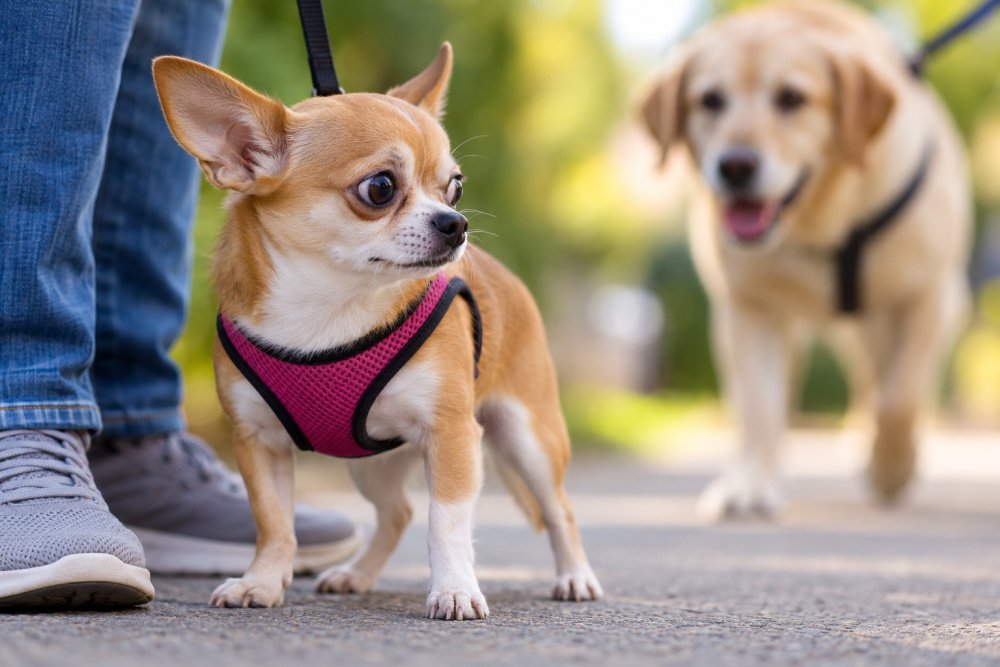
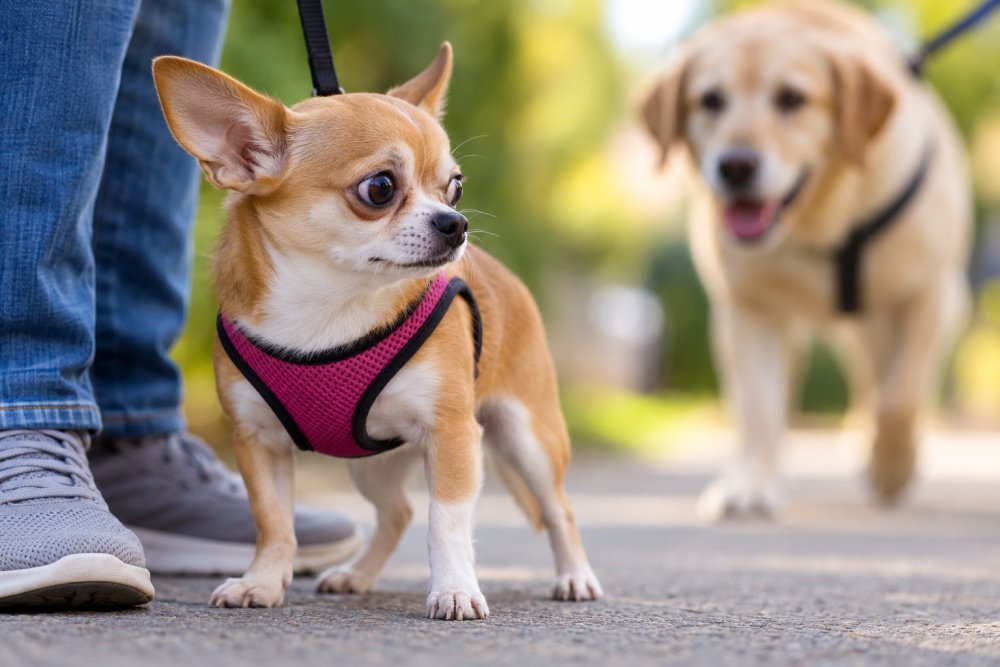
Imagine being 6 pounds and having an excited 70-pound dog bounding toward you wanting to “say hello.” Even if the larger dog is perfectly friendly, that can be pretty intimidating when you’re only a few inches off the ground!
Some Chihuahuas respond to that fear by hiding or trying to escape. Others bark, growl, lunge, or snap. That can look like aggression, but sometimes the real message is simply:
“You’re too close. Please go away!”
Fortunately, there are ways to help a Chihuahua feel safer and more confident around other dogs without forcing them into interactions they aren’t ready for.
Signs Your Chihuahua Is Afraid of Other Dogs
Fear isn’t always as obvious as trembling or running away.
Dogs communicate discomfort in many different ways, and learning your Chihuahua’s early warning signs can help you step in before they become overwhelmed.
Signs of fear or stress may include:
- Tucking the tail
- Pinning the ears back
- Crouching or lowering the body
- Trembling
- Freezing or becoming very still
- Turning the head away
- Lip licking
- Yawning when they aren’t tired
- Trying to hide behind you
- Refusing treats
- Pulling or trying to escape
- Barking
- Growling
- Lunging
- Snapping
That last group is particularly important.
A Chihuahua who barks or lunges at another dog isn’t necessarily trying to start a fight. A frightened dog may discover that making a big, noisy display causes the scary dog to move away.
From the Chihuahua’s point of view, it worked!
That’s one reason fear and reactivity can become more intense over time if the underlying fear isn’t addressed.
Why Is My Chihuahua Scared of Other Dogs?
There isn’t one single reason. Your Chihuahua’s fear may come from their early experiences, personality, past encounters, or a combination of factors.
Lack of Early Socialization
Puppies have an important early socialization period when positive experiences with different people, animals, sounds, surfaces, and environments can help shape how they respond to the world later.
A Chihuahua who had very little positive exposure to other dogs as a puppy may simply not know what to make of them.
However, this doesn’t mean an adult Chihuahua is doomed to be fearful forever. Older dogs can still learn that other dogs aren’t necessarily a threat.
It just needs to happen gradually and at their pace.
A Bad Experience With Another Dog
It may only take one frightening encounter to change how a Chihuahua feels about other dogs.
Perhaps your Chihuahua was:
- Attacked or bitten by another dog
- Chased
- Knocked over during play
- Cornered by an overly enthusiastic dog
- Frightened at a dog park
- Roughly handled by another dog as a puppy
Something a larger dog considers harmless play can be genuinely frightening—or even dangerous—to a Chihuahua.
Other Dogs Are Just Too Much
Sometimes the problem isn’t dogs. It’s a certain type of dog.
Your Chihuahua may be perfectly comfortable with a quiet senior dog but terrified of an adolescent Lab bouncing around like a pogo stick.
Watch for patterns.
Does your Chihuahua react more strongly to:
- Large dogs?
- Dogs that stare?
- Barking dogs?
- Very energetic dogs?
- Dogs that rush toward them?
- Dogs encountered while your Chihuahua is on a leash?
Knowing exactly what triggers the fear makes it much easier to help.
Genetics and Personality
Dogs are individuals. Some are naturally outgoing while others are more cautious.
You can help a cautious Chihuahua become more confident, but you don’t necessarily need to change their personality.
A Chihuahua doesn’t have to love every dog they meet to be a happy, well-adjusted dog.
Pain or a Medical Problem
If your Chihuahua suddenly becomes fearful, irritable, or aggressive around other dogs when they weren’t before, schedule a veterinary exam.
Pain can dramatically change a dog’s behavior.
An older Chihuahua with arthritis, for example, may become much less tolerant of another dog bouncing into them. Vision or hearing changes can also make approaching dogs more startling.
A sudden personality or behavior change is always worth discussing with your veterinarian.
Is It Fear or Aggression?
Sometimes it’s both.
Fear is one of the reasons a dog may behave aggressively.
A frightened Chihuahua usually wants more distance between themselves and whatever is scaring them. If retreat doesn’t seem possible, they may resort to barking, growling, lunging, or snapping.
Think about the classic fight-or-flight response. If “flight” isn’t an option, a frightened dog may choose “fight.”
This is especially relevant when dogs are on a leash because they can’t simply walk away whenever they want.
Don’t punish your Chihuahua for growling. A growl is communication.
Instead, pay attention to what caused it and help your Chihuahua get enough distance to feel safe again.
How to Help a Chihuahua Who Is Afraid of Other Dogs
The solution isn’t to expose your Chihuahua to as many dogs as possible.
In fact, that can make things worse.
The goal is to create small, positive experiences that gradually change how your Chihuahua feels when another dog appears.
1. Start at a Comfortable Distance
Find the distance at which your Chihuahua notices another dog but isn’t panicking.
For one dog, that might be 15 feet.
For another, it might be 50 feet.
That’s okay.
You want your Chihuahua far enough away that they can notice the other dog while still being able to look at you, take treats, sniff the ground, or otherwise behave fairly normally.
If your Chihuahua is barking frantically, lunging, desperately trying to escape, or won’t take a favorite treat, you’re probably too close.
Move farther away.
2. Make Other Dogs Predict Something Wonderful
This is where really good treats come in handy.
When your Chihuahua sees another dog from a comfortable distance, give them something they absolutely love.
The basic idea is:
Dog appears = wonderful things happen.
Eventually, instead of thinking, “Oh no! There’s a dog!” you want your Chihuahua to begin thinking something closer to, “Hey! There’s a dog! Where’s my chicken?”
This technique is called counterconditioning because you’re working to change your dog’s emotional response to something they previously found scary.
3. Gradually Decrease the Distance
As your Chihuahua becomes comfortable, you can gradually work a little closer to other dogs.
The key word here is gradually.
Don’t rush because your Chihuahua did well once.
If they become nervous again, increase the distance. There’s nothing wrong with backing up a step.
This process can take days, weeks, or even months depending on the dog and the severity of their fear.
4. Find a Calm Doggy Friend
If you know someone with a calm, well-mannered dog, that dog may make a wonderful practice partner.
Choose a dog who isn’t going to:
- Rush at your Chihuahua
- Bark in their face
- Chase them
- Paw at them
- Play too roughly
- Ignore signals asking for space
You don’t necessarily need the dogs to greet each other immediately.
Try walking them in the same direction with plenty of space between them. Over time, you can gradually decrease the distance if both dogs remain relaxed.
This type of parallel walking can feel much less threatening than putting two unfamiliar dogs face-to-face and expecting them to become friends.
Don’t Force Your Chihuahua to “Face Their Fear”
If you’re afraid of spiders, being locked in a room filled with spiders probably isn’t going to convince you that spiders are wonderful.
The same principle applies to dogs.
Taking a frightened Chihuahua to a busy dog park or allowing several dogs to surround them doesn’t teach confidence. Overwhelming exposure can make the fear worse.
This is sometimes called flooding.
Instead, keep experiences manageable enough that your Chihuahua can learn while still feeling safe.
Should You Pick Up a Scared Chihuahua?
This one can be tricky because Chihuahuas are so easy to scoop up.
You don’t want picking your Chihuahua up to become your only response whenever another dog appears. Whenever it’s safe and practical, creating more distance and helping your Chihuahua learn to cope can build confidence.
However, safety comes first.
If an off-leash dog is charging toward your tiny Chihuahua, this isn’t the time for a training lesson. Get your dog to safety.
Likewise, you don’t need to ignore or withhold affection from a frightened Chihuahua because you’re worried you’ll “reward the fear.”
Fear is an emotional response, not a trick your dog is performing to earn attention.
You can calmly reassure your Chihuahua while also helping them get farther away from whatever is frightening them.
What NOT to Do With a Fearful Chihuahua
Avoid:
- Forcing your Chihuahua to greet another dog
- Dragging them toward something they’re afraid of
- Punishing barking or growling
- Using leash corrections or other aversive training methods
- Allowing unfamiliar dogs to rush into their space
- Taking a frightened Chihuahua into a crowded dog park
- Assuming every small dog will automatically be a good playmate
- Expecting progress to happen overnight
Punishment may suppress some of the outward behavior without changing the fear underneath it—and can potentially make the association with other dogs even worse.
Instead, reward the behaviors you want and work on changing how your Chihuahua feels about the situation.
Does My Chihuahua Need to Like Other Dogs?
No!
This is something I think we sometimes forget.
Your Chihuahua doesn’t need a huge circle of doggy friends. They don’t need to enjoy dog parks, daycare, or wrestling with the neighbor’s Golden Retriever.
Some dogs are extremely social.
Others would prefer to admire their fellow canines from a respectable distance.
Both are okay.
A much more realistic goal for many fearful Chihuahuas is neutrality.
Can your Chihuahua see another dog across the street without panicking?
Can you pass another dog during a walk?
Can your Chihuahua calmly share a room with a familiar, respectful dog?
Those are wonderful accomplishments.
If your Chihuahua eventually makes a canine friend or two, that’s a bonus.
What About Dog Parks?
I’m not a big fan of using dog parks to socialize a Chihuahua who is already afraid of other dogs.
You have very little control over which dogs will be there or how they will behave. Even friendly dogs can play much too roughly for a tiny Chihuahua.
If you want your Chihuahua to spend time with other dogs, carefully arranged playdates with dogs you know and trust are usually a much more controlled option.
And again, your Chihuahua doesn’t actually need to play with other dogs.
When Should You Get Professional Help?
Mild fear can sometimes improve significantly with patient, reward-based training at home.
However, professional help is a good idea if your Chihuahua:
- Regularly lunges or snaps at other dogs
- Has bitten another dog
- Is so frightened that normal walks are difficult
- Panics even when other dogs are far away
- Is becoming increasingly reactive
- Isn’t improving despite your efforts
- Suddenly develops fear or aggression that wasn’t there before
Start with your veterinarian, particularly if the behavior appeared suddenly. You’ll want to rule out pain or another medical issue.
For more serious behavior problems, your veterinarian may recommend working with a qualified reward-based trainer or veterinary behaviorist.
Be Patient With Your Chihuahua
Helping a Chihuahua overcome fear isn’t about showing them who’s boss or forcing them to “get over it.”
It’s about helping them learn that they are safe.
Pay attention to your dog’s body language. Give them space when they need it. Reward calm behavior and create positive experiences with other dogs from a distance your Chihuahua can handle.
And celebrate the little victories.
The first time your Chihuahua sees another dog and looks back at you instead of barking may not seem like a big deal to anyone else.
But you know better.
That’s progress!
With patience, consistency, and lots of positive experiences, many fearful Chihuahuas can become much more comfortable around other dogs—even if they never become the life of the dog park.
Frequently Asked Questions
Why is my Chihuahua suddenly afraid of other dogs?
A sudden behavior change can sometimes be caused by pain, illness, changes in vision or hearing, or a frightening encounter with another dog. If the fear appeared suddenly, especially in an older Chihuahua, schedule a veterinary examination to rule out a medical cause.
Why does my Chihuahua bark at every dog we see?
Barking can have several causes, including fear, excitement, frustration, or territorial behavior. Look at the rest of your Chihuahua’s body language. A tucked tail, crouched posture, pinned ears, attempts to escape, or hiding behind you suggest fear may be involved.
Should I let my scared Chihuahua meet other dogs?
Don’t force greetings. Start far enough away that your Chihuahua can see another dog without becoming frightened. Reward calm behavior and gradually decrease the distance over time. A calm, predictable dog can eventually make a good practice partner.
Can an older Chihuahua learn to be comfortable around other dogs?
Yes. Although early puppy socialization is important, adult and senior dogs can still learn new associations. Progress may be gradual, particularly if the fear has existed for years, but older dogs can absolutely become more comfortable.
Should I take my fearful Chihuahua to a dog park to socialize them?
No. A busy dog park can overwhelm a Chihuahua who is already afraid of dogs. Controlled exposure from a comfortable distance and carefully chosen interactions with calm dogs are better options.
Is it okay if my Chihuahua never wants to play with other dogs?
Absolutely. Your Chihuahua doesn’t need to enjoy playing with other dogs. Being able to calmly see or pass another dog without becoming frightened is a perfectly good goal.
ALSO READ: Why are Chihuahuas so Scared?
Pet Blogger
I have had dogs all my life. I have been a pet groomer, worked in a pet hotel, and a kennel, and have bred and showed dogs.

Post Views: 5,564